
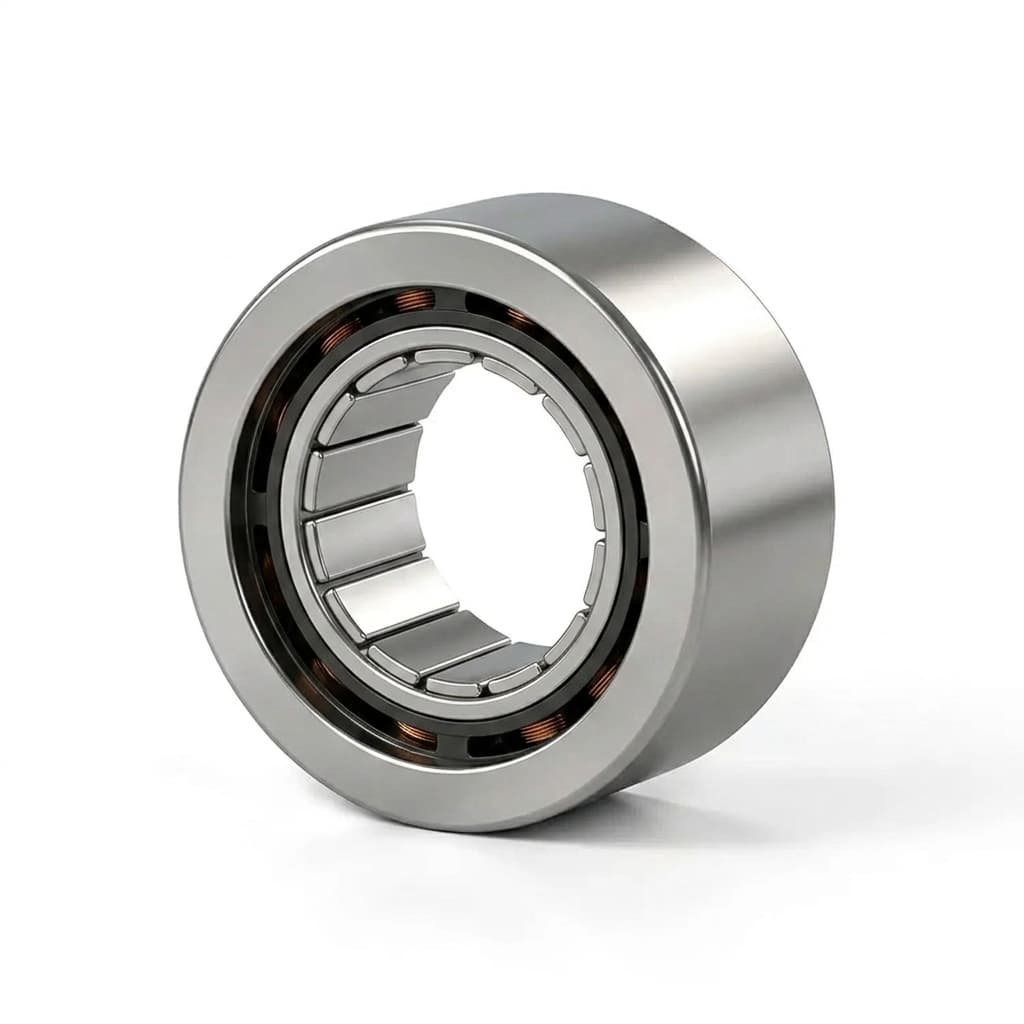
Frameless Servo Motor Thermal Design: Why Air Gaps Kill Continuous Torque
A deep dive into the thermal bottlenecks of frameless motor integration. Learn how housing materials, potting compounds, and micro-air gaps drastically alter continuous torque and why catalog values need derating.
When engineers select a frameless servo motor, they usually look at the torque-speed curve first. They see a "Continuous Torque" value, check if it meets their requirement, and move to mechanical CAD.
This is the most common integration failure mode in direct-drive robotics.
A frameless motor has no outer housing. It has no cooling fins. It has no fan. The motor does not have a continuous torque rating—the entire thermal assembly has a continuous torque rating. The stator is merely the heat source; the customer's housing is the heat sink. If the thermal path between the two is flawed, a motor rated for 2.0 N·m on paper will overheat at 1.0 N·m in reality.
This guide explains the real-world thermal bottlenecks of frameless integration, how to calculate thermal derating, and what OEM buyers must review before freezing a CAD design.
The Bottleneck: I²R Losses vs. Thermal Resistance
In a permanent magnet motor, the primary heat source during continuous operation is copper loss (I²R losses) in the stator windings. The heat must flow from the copper coils $\rightarrow$ through the electrical insulation $\rightarrow$ into the stator lamination stack $\rightarrow$ across the mounting interface $\rightarrow$ into the machine housing $\rightarrow$ and finally to the ambient environment.
The stator generates heat. The housing acts as the sink. An air gap or poor potting limits continuous torque by creating a thermal bottleneck.
As seen in the diagram above, the most critical chokepoint is the stator-to-housing interface.
Even if you use aerospace-grade aluminum for your housing, if the stator is loosely fitted and separated by a microscopic air gap, the thermal resistance skyrockets. Air is a terrible thermal conductor (approx. 0.024 W/m·K).
Derating Matrix: How Housing and Fit Impact Continuous Torque
Catalog continuous torque values are typically measured under ideal conditions: the stator is pressed into a massive, actively cooled aluminum fixture in a 25°C ambient room.
Your application is likely a compact, sealed robotic joint or a closed medical actuator. You must derate the catalog value. Use the following diagnostic table as a baseline before you have physical prototypes.
| Housing Material | Integration Method | Estimated Continuous Torque Yield | Engineering Action |
|---|---|---|---|
| Aluminum (~160 W/m·K) | Interference fit (Shrink-fit) + Thermal Paste | 95% - 100% | Standard high-performance baseline. Ensure housing wall is thick enough to spread heat axially. |
| Aluminum | Slip fit with Epoxy / Potting Compound (~1.0 W/m·K) | 85% - 95% | Highly dependent on potting thickness. Keep the gap under 0.1mm. Ensure void-free injection. |
| Steel (~50 W/m·K) | Interference fit (Shrink-fit) | 70% - 80% | Steel holds heat. You must increase the surface area of the housing or add external convection to compensate. |
| Aluminum / Steel | Slip fit with Set Screws (Air Gap) | 40% - 50% | High Risk. The air gap creates a severe thermal wall. Only acceptable for low-duty-cycle or peak-torque-only applications. |
| Polymer / Plastic | Any | < 30% | Plastics act as thermal insulators. The motor will overheat rapidly under continuous load. Re-evaluate design. |
Crucial Rule: Never use set-screws to mount a frameless stator if you need high continuous torque. The localized pressure distorts the lamination stack, and the resulting air gap traps heat inside the windings.
Calculating the Thermal Stack-Up
To mathematically predict if your motor will overheat, you need to understand the thermal resistance network.
The temperature rise of the winding (ΔT_winding) is calculated as:
ΔT_winding = P_loss × (R_th_internal + R_th_interface + R_th_housing)
- P_loss: Total power dissipated as heat (Watts).
- R_th_internal: Thermal resistance from coils to the outer diameter of the stator (Provided by the motor supplier).
- R_th_interface: Thermal resistance of your mounting gap (This is under your control).
- R_th_housing: Thermal resistance of your housing to ambient air.
If ΔT_winding + T_ambient exceeds the insulation temperature limit (often 130°C or 155°C), the motor will burn out.
The Math Behind the Air Gap
Why is an air gap so destructive? Let's look at the thermal conductivity ($k$):
- Aluminum:
167 W/m·K - Thermal Epoxy:
1.0 - 2.5 W/m·K - Static Air:
0.024 W/m·K
An air gap of just 0.05 mm has the same thermal resistance as 3.5 mm of standard thermal epoxy, or nearly 350 mm of solid aluminum! If your slip-fit tolerance is too loose and you don't backfill it with thermal resin, the heat has nowhere to go.
Three Actionable Design Strategies
If your continuous torque requirements are close to the catalog limit, you must optimize the interface.
1. The Shrink-Fit (Interference Fit)
This is the gold standard for robotics. The aluminum housing is heated to expand, the room-temperature stator is dropped in, and as the housing cools, it clamps down on the stator.
- Advantage: Near-zero thermal resistance at the interface. Maximum torque density.
- Risk: If the interference is too high, the compressive stress can deform the stator laminations, altering the magnetic properties and increasing cogging torque. For most frameless motors in the 60-120mm OD range, the recommended interference is 0.01-0.03mm. Always request the supplier's recommended compression limits before machining the housing bore.
2. The Potted Slip-Fit
The stator is machined with a slight clearance fit (e.g., +0.05mm). The gap is injected with a high-conductivity thermal epoxy.
- Advantage: Zero compressive stress on the stator. Much easier assembly and lower tooling cost.
- Risk: Potting compounds can have bubbles (voids). Voids are microscopic air gaps that create localized hotspots, leading to premature winding failure. Vacuum potting is highly recommended. We have seen bubble-related winding burnout on a 110mm motor where standard gravity-fill potting left a 3mm void pocket near the hottest coil.
3. Housing Surface Area Optimization
The heat doesn't just stop at the housing—it must escape to the air. A smooth, compact cylinder has very little surface area.
- Action: If you cannot add cooling fins due to space constraints (e.g., a cobot arm), you must ensure the housing is mechanically coupled to larger, thermally conductive machine structures (like the robot's main links) to act as extended heat sinks.
The following chart shows what happens in practice when you change only the mounting method while keeping everything else identical:
Same 80mm OD motor, same 1.2 N·m continuous load, same aluminum housing. Only the mounting method changes. The set-screw mount reaches thermal shutdown in under 12 minutes.
The data comes from bench tests on an 80mm OD frameless motor running at 1.2 N·m continuous. The shrink-fit assembly stabilized at 78°C with comfortable margin below the 130°C Class-B insulation limit. The potted slip-fit reached 95°C—still within spec but with less margin for higher ambient temperatures. The set-screw mount hit thermal shutdown at 130°C in under 12 minutes, at the same load the other two methods handled easily.
How to Verify Thermal Performance with a Prototype
You do not need a thermal simulation lab to validate the supplier's claims. A K-type thermocouple, a handheld data logger, and 30 minutes of testing can reveal whether the integration is thermally sound.
Prototype thermal validation procedure:
- Attach a K-type thermocouple to the housing outer surface directly above the stator center, using thermal paste and Kapton tape.
- If possible, route a second thermocouple into the end-winding area (between the stator and the housing endcap). This gives you the most critical temperature reading.
- Run the motor at 100% of the target continuous torque at the target speed.
- Log temperature every 30 seconds for at least 20 minutes, or until the temperature stabilizes (rate of change less than 1°C per 5 minutes).
- Record the steady-state housing temperature and the steady-state winding temperature (if accessible).
How to interpret the results:
| Measurement | Acceptable Range | Warning | Action Required |
|---|---|---|---|
| Housing surface temp (steady-state) | Below 60°C | 60-75°C | Above 75°C — improve thermal path or derate |
| Winding temp (if measurable) | Below 110°C | 110-130°C | Above 130°C — risk of insulation failure |
| Time to reach steady state | 15-25 min | 8-15 min (fast rise suggests poor thermal coupling) | Under 8 min — likely air gap or poor contact |
| Temperature difference (winding - housing) | Below 30°C | 30-50°C | Above 50°C — the interface is the bottleneck |
The most important number is the winding-to-housing temperature difference. If the housing is 45°C but the winding is 120°C, you have a 75°C delta across the interface—this means the thermal resistance between stator and housing is unacceptably high, regardless of what the housing surface looks like.
What to Request from Your Frameless Motor Supplier
When submitting an RFQ, do not just send a peak torque target. Send a thermal profile.
Ask the supplier for:
- R_th (Thermal Resistance): What is the resistance from winding to stator OD? A good supplier will provide a number in °C/W. Typical values for frameless motors range from 0.5 to 3.0 °C/W depending on motor size and construction.
- Test Conditions: Was the catalog continuous torque measured on an aluminum plate? What size? What was the ambient temperature? Most catalog values assume a 300mm x 300mm x 20mm aluminum plate at 25°C—far better than most real housings.
- Maximum Housing Temperature: At continuous load, what should the temperature of the external housing be? (This allows you to verify the interface quality during prototype testing using the thermocouple method above).
At Frameless Servo, we provide application-specific thermal derating assistance. If you are designing a sealed actuator and need to know the true continuous torque boundary, share your housing material and ambient conditions via our Contact / RFQ page before you lock your CAD design.
Author

Categories
More Posts
How to Address Cogging Torque in Frameless Servo Motors: Slotted vs. Slotless Designs
A comprehensive engineering and procurement guide to evaluating cogging torque in direct-drive frameless servo motors. Compare slotted and slotless designs for precision applications.
Frameless Servo Motor CAD Files: What Engineers Should Check Before Requesting STEP or IGES
A buyer-side guide to requesting frameless servo motor CAD files, including OD, ID, stack height, datum, cable exit, and revision controls before sample release.
How to Read a Frameless Servo Motor Torque-Speed Curve Before You Select a Motor
Learn how engineers should interpret continuous torque, peak torque, bus voltage, thermal limits, and duty cycle when reading torque-speed curves for frameless servo motors.