
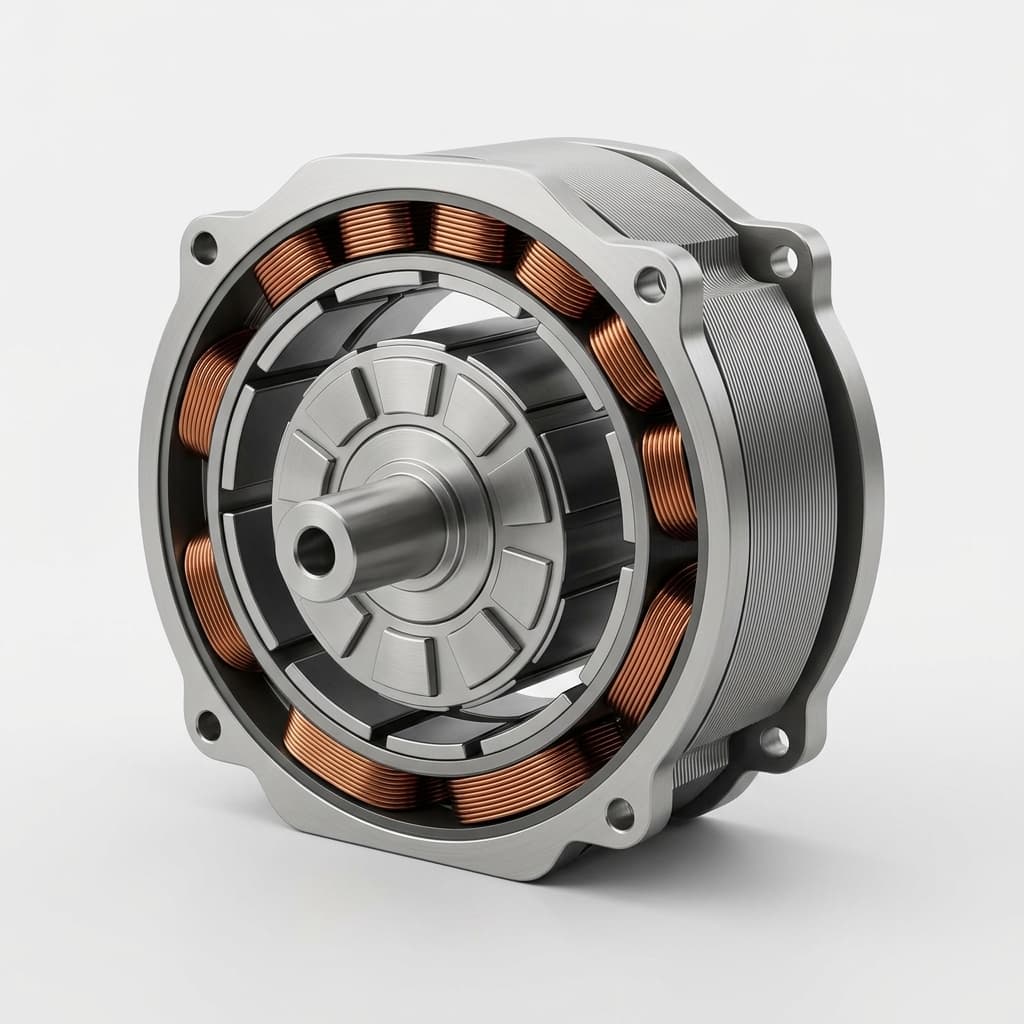
Frameless Motor Magnet Grades: NdFeB SH/UH/EH Guide
Procure frameless servo motor magnet grades with a practical SH, UH, and EH selection framework, thermal margins, evidence requests, and RFQ checks.
When evaluating frameless motor quotations, procurement teams often face a confusing scenario: two motors with identical physical dimensions and similar nominal torque ratings can have a price difference of 20% to 40%. In many cases, the hidden cost driver is not the copper winding or the steel stator core. It is the specific grade of the Neodymium-Iron-Boron (NdFeB) permanent magnets mounted on the rotor.
Frameless servo motors are frequently integrated into compact, enclosed spaces like robotic joints, surgical arms, or optical gimbals. In these restricted environments, heat cannot escape easily. Standard neodymium magnets lose their magnetic properties—sometimes permanently—when exposed to high temperatures. To prevent this, motor manufacturers use specialized magnet grades (such as SH, UH, or EH) that incorporate heavy rare earth elements to increase thermal stability.
This guide explains how NdFeB magnet grading works, why coercivity matters to your supply chain, and how engineering and procurement teams can balance thermal requirements against the volatile costs of heavy rare earth elements.
If you are preparing a supplier package now, pair this guide with the frameless motor thermal design guide and our Datasheet Library. The procurement output should be a shortlist of acceptable magnet suffixes, a maximum rotor temperature assumption, and the evidence you will ask the supplier to attach to the quote.
Research basis and scope: This article was reviewed on 2026-06-23 for global OEM procurement of NdFeB-based frameless servo motor kits. It covers magnet grade selection for compact direct-drive motors; it does not replace project-specific electromagnetic FEA, rotor permeance review, thermal testing, or regulatory qualification for aerospace, medical, or safety-rated assemblies.
The Chemistry of Frameless Motor Magnets
Permanent magnet motors rely on the magnetic field generated by the rotor to interact with the electromagnetic field of the stator. Neodymium magnets (NdFeB) are the industry standard for high-performance frameless motors because they offer the highest energy product of any commercially available magnetic material. This high energy density is what allows frameless motors to deliver massive torque from a very small package.
However, NdFeB magnets have a critical weakness: temperature sensitivity. As the temperature of the magnet rises, its magnetic strength temporarily decreases. If the temperature exceeds a specific threshold—known as the Maximum Operating Temperature—the magnet will suffer irreversible demagnetization. Even after the motor cools down, the magnet will not recover its original strength, permanently reducing the motor's torque output and efficiency.
To counteract this vulnerability, magnet manufacturers add Heavy Rare Earth Elements (HREEs)—specifically Dysprosium (Dy) and sometimes Terbium (Tb)—to the alloy. These elements dramatically increase the magnet's intrinsic coercivity (Hcj), which is the material's resistance to demagnetization.
For a buyer, this creates a direct correlation: higher temperature resistance requires more Dysprosium. Because Dysprosium is scarce, expensive, and subject to geopolitical supply chain constraints, specifying a higher temperature grade directly impacts the Bill of Materials (BOM) cost and lead-time stability of your frameless motor.
What NdFeB Grade Suffixes Actually Mean
Neodymium magnet grades follow a standard naming convention, such as N42SH or N38UH.
- The "N" and the number (e.g., 42, 38) indicate the Maximum Energy Product (BHmax), measured in Mega-Gauss Oersteds (MGOe). This represents the raw magnetic strength.
- The letters at the end (e.g., SH, UH) represent the Temperature Grade based on intrinsic coercivity.
For frameless motors, the suffix is arguably more important than the N-number. Below is a comprehensive breakdown of standard temperature suffixes, their maximum operating temperatures, and their typical application environments in the motion control industry.
| Grade Suffix | Meaning | Max Operating Temp (°C) | Intrinsic Coercivity Hcj (kOe) | Typical Motor Application | Relative HRE Cost Impact | Supplier Availability | Demagnetization Risk Profile |
|---|---|---|---|---|---|---|---|
| (None) | Standard | 80°C (176°F) | ≥ 12 | Low-cost consumer electronics, toys. Rarely used in servo motors. | Lowest | Ubiquitous | Extremely High in closed systems |
| M | Medium | 100°C (212°F) | ≥ 14 | Open-frame blowers, light-duty steppers. | Low | Excellent | High if stalled or overloaded |
| H | High | 120°C (248°F) | ≥ 17 | General automation, lightly loaded BLDC motors. | Moderate | Excellent | Moderate |
| SH | Super High | 150°C (302°F) | ≥ 20 | Standard industrial frameless servo motors, robotic arms. | High | Good | Low under normal servo control |
| UH | Ultra High | 180°C (356°F) | ≥ 25 | High-performance robotics, traction motors, enclosed actuators. | Very High | Restricted / Special Order | Very Low |
| EH | Extra High | 200°C (392°F) | ≥ 30 | Aerospace, demanding traction, severe high-ambient environments. | Premium | Limited / Long Lead Time | Negligible |
| AH/VH | Advanced High | 230°C (446°F) | ≥ 35 | Extreme downhole drilling, specialized defense applications. | Extreme | Rare | Negligible |
| TH | Top High | 240°C (464°F) | ≥ 40 | Niche survival environments exceeding standard EH limits. | Astronomical | Prototype/Custom | Negligible |
Note: The actual maximum operating temperature also depends heavily on the permeance coefficient (the shape and magnetic circuit design of the rotor). The temperatures above are industry benchmarks.
For RFQ screening, do not treat this table as a guaranteed operating envelope. Ask the supplier to confirm whether the grade is sintered NdFeB, whether the suffix is certified on the finished rotor magnet geometry, and whether the quoted motor was tested after adhesive cure, rotor balancing, and any coating process that can add thermal or mechanical stress.
The Engineering Trade-Off: Strength vs. Heat Resistance
It is a common misconception that you can simply specify the strongest magnet with the highest temperature rating—for example, an "N52EH". This grade does not exist.
The metallurgical chemistry of NdFeB dictates an inverse relationship between Remanence (Br, which correlates to the "N" number) and Intrinsic Coercivity (Hcj, the temperature suffix). Adding Dysprosium to increase coercivity takes up physical space in the crystal lattice, leaving less room for Iron and Neodymium, which provide the magnetic strength.
When specifying a frameless motor, engineering teams must find the optimum balance point on this curve. Moving from an N48H to an N38UH to survive higher temperatures means you are fundamentally reducing the magnetic flux in the air gap. To maintain the same torque output, the motor will need to draw more current, which in turn generates more heat—potentially defeating the purpose of the upgrade.
Dysprosium and the Heavy Rare Earth (HRE) Supply Chain
From a procurement perspective, specifying an SH, UH, or EH grade introduces supply chain volatility. Dysprosium and Terbium are heavily concentrated in a few global mining operations, predominantly in China.
When demand for high-performance traction motors (like those in Electric Vehicles) surges, the commodity price of Dysprosium spikes. Because high-temperature frameless motors require significant percentages of these elements by weight, the magnet cost can fluctuate wildly.
The "Heavy Rare Earth Free" Trend: To mitigate this risk, leading magnet manufacturers are developing HRE-free or reduced-HRE technologies. Through advanced grain boundary diffusion (GBD) processes, manufacturers can infuse Dysprosium only into the outer shell of the magnet crystals rather than mixing it uniformly throughout the alloy. This can achieve SH or UH temperature ratings while drastically reducing the total amount of Dysprosium used, shielding buyers from extreme price volatility.
When qualifying a new frameless motor supplier, asking whether their UH grade magnets utilize Grain Boundary Diffusion is a hallmark of a sophisticated procurement team.
For production sourcing, add one commercial question to the technical review: "What portion of the quoted price is exposed to Dy/Tb surcharge or magnet-grade substitution?" A supplier may not disclose exact alloy cost, but they should be able to state whether SH, UH, and EH options share the same lead-time class, whether alternate grades are pre-qualified, and whether a grade change triggers new back-EMF, no-load current, and thermal run-in acceptance tests.
Sourcing Strategy: Over-Specifying vs. Under-Specifying
Navigating motor specifications requires avoiding two common extremes:
The Risk of Over-Specifying (The "EH" Trap): An engineer designing a robotic joint might calculate a peak internal temperature of 110°C. Applying an overly conservative safety factor, they might specify an EH (200°C) rated magnet.
- The Result: The buyer is forced to pay a massive premium for Dysprosium content that will never be utilized. Furthermore, because EH magnets have lower Remanence, the motor efficiency drops, leading to faster battery drain in mobile robotics.
- The Rule of Thumb: A 20°C to 30°C safety margin above maximum worst-case temperature is industry standard. If the peak internal temperature is 110°C, an SH (150°C) grade provides ample protection.
The Risk of Under-Specifying (The Cheap Prototype): A buyer sources a low-cost frameless motor prototype that uses a standard H (120°C) grade magnet. It performs beautifully on the test bench in an air-conditioned lab. But when integrated into a sealed aluminum robot arm and run at continuous duty, the internal temperature hits 135°C.
- The Result: Irreversible demagnetization occurs. The motor permanently loses 15% of its torque capacity, and the control loop becomes unstable. The entire mechanical assembly must be scrapped.
Procurement and Engineering Checklist
Before finalizing a purchase order or signing off on a custom frameless motor design, use this checklist to align engineering requirements with supply chain realities.
- Verify Internal Temperatures: Have we modeled or physically measured the internal rotor temperature inside our specific enclosed housing, not just the ambient air temperature?
- Define the Safety Margin: Does the chosen magnet grade suffix exceed our maximum internal temperature by at least 20°C?
- Check the Quotation: Does the supplier's datasheet explicitly state the NdFeB grade (e.g., N42SH)? Beware of generic "Neodymium Magnet" descriptions.
- Question HRE Content: For UH or EH grades, have we asked the supplier if they utilize Grain Boundary Diffusion (GBD) to optimize cost and reduce supply chain risk?
- Confirm Demagnetization Testing: Will the supplier provide a sample acceptance test report confirming back-EMF values remain stable after a thermal run-in test?
- Align Winding Insulation: Does the stator winding insulation class (e.g., Class F 155°C or Class H 180°C) logically match the rotor's magnet temperature grade? (A Class F stator with an EH rotor is a mismatch).
- Tie the Grade to QC Evidence: Does the outgoing inspection package connect magnet grade, rotor lot, back-EMF constant, no-load current, and thermal run-in date for traceability?
- Protect Reorders: Does the purchase specification prevent silent substitution from UH to SH, from GBD to conventional Dy-heavy material, or from one magnet supplier to another without written approval?
FAQ: NdFeB Magnets in Frameless Motors
Q: Can a demagnetized frameless motor be repaired? In most cases, no. Re-magnetizing a rotor requires specialized fixturing and exact alignment. For frameless motors, the cost of extracting the rotor from the customer's assembly and returning it to the factory usually exceeds the cost of a new rotor. Prevention through proper grade selection is the only viable strategy.
Q: If I use liquid cooling in my housing, can I use a lower magnet grade? Yes. Efficient thermal management (like a water jacket around the stator) drastically lowers the rotor temperature. This allows you to step down from a UH to an SH or H grade, saving BOM cost and potentially allowing for a higher "N" number magnet, which increases motor efficiency.
Q: Are Samarium Cobalt (SmCo) magnets better for high temperatures? Samarium Cobalt (SmCo) magnets have excellent thermal stability and can easily operate at 250°C to 300°C without the severe drop-off seen in NdFeB. However, SmCo has a significantly lower maximum energy product (BHmax) than Neodymium and is more brittle. They are usually reserved for aerospace, defense, or extreme downhole drilling where NdFeB EH grades cannot survive.
Q: Does the potting compound affect magnet temperature? Stator potting improves thermal conductivity from the copper windings to the external housing, effectively lowering the overall motor temperature. By keeping the stator cooler, the radiant heat reaching the rotor magnets is reduced, adding an extra layer of thermal safety.
Q: What should I send to a supplier before asking for SH, UH, or EH pricing? Send the target continuous torque and speed, peak torque duration, bus voltage, housing material, mounting contact area, maximum ambient temperature, duty cycle, cooling method, and any measured winding or rotor temperature from a prototype. If rotor temperature is unknown, ask for both the assumed temperature model and the test method used to validate it.
Sources
This guide synthesizes magnet-grade data, manufacturer material notes, and current rare-earth supply-chain references. Public sources can define grade classes and risk factors; the final procurement decision should still be validated against the supplier's dated datasheet, rotor drawing, and test report for the exact motor geometry.
| Source Authority | Why it matters to this guide | Verification Link |
|---|---|---|
| Mainrich Magnets | Explains NdFeB grade naming and suffix classes such as M, H, SH, UH, and EH for procurement interpretation. | Neodymium magnet grades explained |
| e-Magnets UK | Provides a supplier-side reference for neodymium temperature ratings and the operating-temperature role of suffix grades. | Neodymium temperature ratings |
| Arnold Magnetic Technologies | Documents NdFeB magnet families and grain boundary diffusion as a way to balance energy density, temperature stability, and cost. | Neodymium Iron Boron magnets |
| Arnold Magnetic Technologies | Provides a direct catalog reference for Grain Boundary Diffused Neo magnets and reduced dysprosium use. | Grain Boundary Diffused Neo catalog |
| USGS Mineral Commodity Summaries 2026 | Gives current public context for rare-earth supply concentration and export-control risk affecting dysprosium and terbium. | Rare Earths 2026 summary |
| Applied Magnets | Cross-checks practical grade examples such as N45M and N42SH with maximum operating temperature claims. | Neodymium magnet properties and ratings |
Ready to Specify Your Next Frameless Motor?
Choosing the right magnet grade is a delicate balance between performance, thermal survival, and unit cost. Frameless Servo specializes in optimizing these variables for your specific application environment, ensuring you never pay for unnecessary Dysprosium while guaranteeing reliability in the field.
Review our standard magnetic configurations in the Datasheet Library, compare thermal assumptions in the thermal design guide, and use the Back-EMF quality-control guide to define acceptance evidence. For a project-specific grade recommendation, send the operating envelope through the Contact / RFQ page and ask us to review SH, UH, EH, and Grain Boundary Diffusion options against your direct-drive duty cycle.
Author

Categories
More Posts
How to Read a Frameless Servo Motor Torque-Speed Curve Before You Select a Motor
Learn how engineers should interpret continuous torque, peak torque, bus voltage, thermal limits, and duty cycle when reading torque-speed curves for frameless servo motors.
Back-EMF Testing for Frameless Motors: Why It Matters in Supplier Quality Control
A practical guide for OEM buyers on using Back-EMF waveform, phase difference, THD, resistance, and insulation checks to qualify frameless motor suppliers.
How to Address Cogging Torque in Frameless Servo Motors: Slotted vs. Slotless Designs
A comprehensive engineering and procurement guide to evaluating cogging torque in direct-drive frameless servo motors. Compare slotted and slotless designs for precision applications.