
Flat servo motor sizing tool
Flat servo motor matcher for 1 HP / 750 W class applications
Use the calculator first to test torque, speed, and axial length. Then review the evidence, limits, and RFQ checks before treating a 1 horsepower flat servo motor as the right fit.
Canonical routing note
The alias phrase 1 horsepower flat servo motor is covered on this single canonical page:/learn/flat-servo-motor
Decision Summary
The headline answer is not "flat is always better." A flat servo motor is worth quoting when the same duty point must fit into a shorter axial package and the machine can provide a credible heat path.
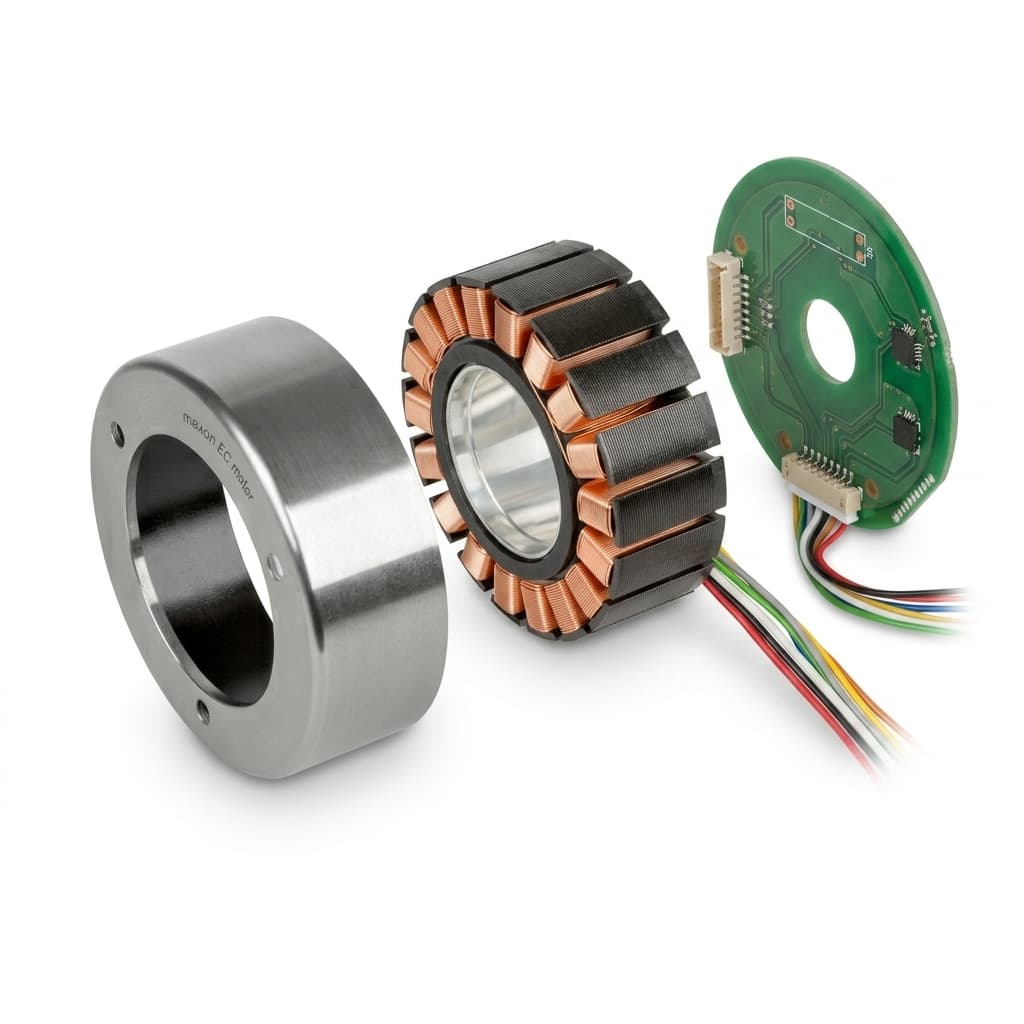
Why flat geometry changes the selection
The drawing is not a product blueprint. It shows the trade: shorter axial length usually means larger diameter, different inertia, tighter bearing spacing, and more dependence on the mounting structure for heat.
Evidence and Method
Time-sensitive statements are marked with the June 20, 2026 review date. Where public product evidence is too broad to prove a universal number, the table states the boundary instead of inventing a market average.
| Evidence | Date | What it supports | Decision use |
|---|---|---|---|
| NIST Handbook 44 current edition | Checked 2026-06-20 | NIST Handbook 44 includes SI conversion appendices; one horsepower is commonly converted as about 745.7 watts. | Supports treating a 1 horsepower flat servo motor as the 750 W servo class rather than a separate product category. |
| Power, torque, and speed relationship | Reviewed 2026-06-20 | Mechanical power in kW is calculated as torque in Nm multiplied by rpm divided by 9550. | The matcher uses this formula to convert an application duty point into a 750 W fit screen. |
| Omron 1S servo motor datasheet | Reviewed 2026-06-20 | A 750 W, 3000 rpm servo row is listed with 2.39 Nm rated torque in the referenced 1S series datasheet. | Gives a practical 750 W screening baseline, not a universal guarantee for every supplier or flat topology. |
| Oriental Motor motor sizing guidance | Reviewed 2026-06-20 | Motor sizing requires torque, speed, stopping accuracy, and system inertia rather than a power label alone. | Explains why the page scores speed, torque, inertia-sensitive use, and packaging separately. |
1 HP flat servo vs standard servo
Compare by duty point and constraint, not by the power label alone. The same 1 hp power class can lead to different machine outcomes.
| Metric | Flat servo motor | Standard servo motor | Selection impact |
|---|---|---|---|
| Power class | 1 hp / 750 W class | 1 hp / 750 W class | Power label alone does not justify a flat design. |
| Continuous torque screen | ~2.4 Nm at 3000 rpm baseline | ~2.4 Nm at 3000 rpm baseline | Use the same duty-point math before comparing geometry. |
| Axial envelope | Short body, larger diameter | Longer body, smaller diameter | Flat wins when machine length is the limiting dimension. |
| Rotor inertia | Often higher because diameter grows | Often lower for the same power class | Fast indexing may prefer a conventional motor plus gearing. |
| Thermal dissipation | Frame-dependent conduction path | More standalone housing mass and surface area | Thermal mounting must be part of the RFQ, not an afterthought. |
| Shaft and radial load | Bearing span can be shorter | Bearing span can be more forgiving | Wheel, belt, and cantilever loads need separate bearing review. |
Boundaries and Risk Controls
These are the checks that keep the tool result from becoming an unsafe shortcut. Treat any unresolved item as an RFQ question.
Good-fit situations
- AGV or AMR wheel modules with tight axial packaging.
- Robot joints where a shorter motor improves envelope.
- Rotary fixtures where center of gravity matters.
- Retrofits that must keep the existing machine depth.
Avoid or validate carefully
- Very high speed axes above the basic 1 hp review envelope.
- Large belt, wheel, or cantilever shaft loads.
- Thermally isolated mounting surfaces.
- Cost-sensitive machines where a standard servo fits.
| Risk | Trigger | Mitigation |
|---|---|---|
| Misusing horsepower as the only sizing input | Selecting 1 hp without torque-speed, duty cycle, or peak load | Use the calculator as a first screen, then request the supplier torque-speed curve and thermal assumptions. |
| Thermal derating in compact mounting | Plastic, thin sheet, or isolated mounting surface | Specify heat-sink material, contact area, ambient temperature, and continuous duty in the RFQ. |
| Scene mismatch for high-speed indexing | Speed above 4000 rpm or very low inertia requirement | Compare standard servos, smaller motors with gearing, or custom winding before locking a flat package. |
| Radial load overload | Direct wheel, belt, or cantilevered load on the motor shaft | Ask for bearing load ratings or isolate load through external bearings. |
| Cost surprise | Custom stator, rotor, shaft, encoder, brake, cable, or potting | Quote motor-only, motor-plus-drive, and validated axis package separately. |
RFQ checklist
If the tool says the motor is plausible, the next step is not a blind purchase. Send enough application data for the supplier to validate the real continuous and peak duty.
Send sizing requestFAQ
Decision-focused answers for the flat servo motor topic and the 1 horsepower alias.
Ready to validate a flat servo motor?
Share the duty point and mechanical envelope. We will help decide whether the 1 HP / 750 W flat class is enough or if a different servo architecture is safer.