
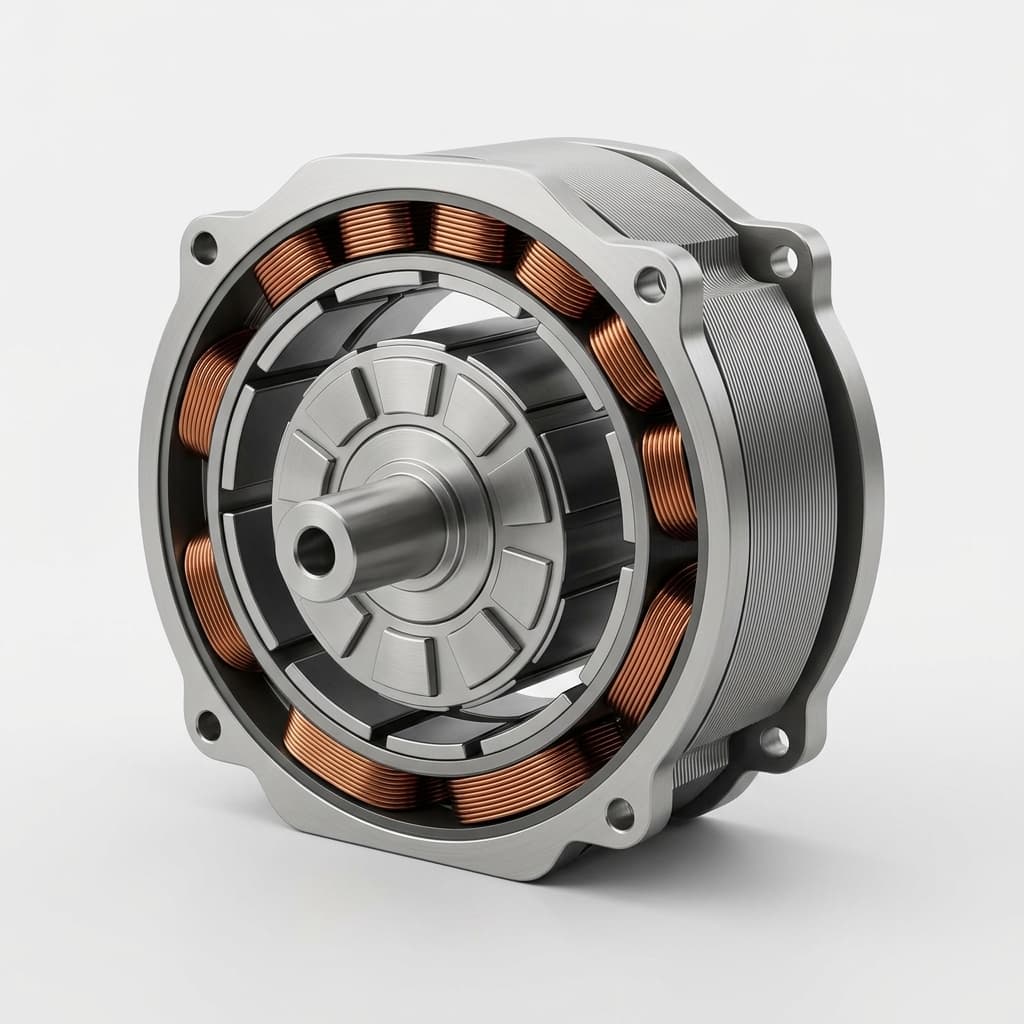
Back-EMF Testing for Frameless Motors: Why It Matters in Supplier Quality Control
A practical guide for OEM buyers on using Back-EMF waveform, phase difference, THD, resistance, and insulation checks to qualify frameless motor suppliers.
Back-EMF testing is one of the most useful quality-control tools for permanent-magnet motor production. For frameless motors, it is especially valuable because the buyer often integrates the stator and rotor into a custom housing where small motor inconsistencies can become system-level noise, heat, or control instability.
We learned this the hard way. A European robotics customer once received a batch of 50 stators where basic resistance and insulation checks all passed. But when they ran the motors at low speed under servo control, three units produced audible 400 Hz whine. The root cause was a 12% amplitude imbalance between Phase-U and Phase-V caused by inconsistent magnet placement during assembly. A simple Back-EMF waveform comparison at incoming inspection would have caught this before integration.
This article explains what Back-EMF testing can reveal, why phase difference and harmonic distortion matter, and what OEM buyers should ask for when qualifying a frameless motor supplier.
What Back-EMF means in practical terms
When a permanent-magnet rotor spins relative to the stator winding, voltage is induced in the stator phases. That induced voltage is Back-EMF. The waveform shape and phase relationship provide useful evidence about the magnetic circuit, winding consistency, and assembly quality.
For a buyer, the important point is simple:
Back-EMF testing can help identify hidden problems before the motor reaches the customer's assembly line.
It is not the only test required, but it is a strong early indicator.
What Back-EMF testing can reveal
Back-EMF testing can help detect or screen for:
- Winding asymmetry.
- Magnetization inconsistency.
- Rotor/stator assembly deviation.
- Phase sequence or phase balance issues.
- Waveform abnormalities that may affect drive tuning.
- Lot-to-lot drift in motor electrical behavior.
For frameless motor kits, these risks matter because the final motor package is completed by the customer's mechanical structure. If a defect is discovered only after integration, the cost of troubleshooting is much higher.
What a useful Back-EMF report should include
For supplier qualification, a report should not only say "pass." It should help the buyer understand test context, acceptance logic, and traceability.
| Report field | Why it matters |
|---|---|
| Product model and revision | Confirms the test belongs to the exact motor option under review. |
| Lot number or serial number | Supports issue containment and repeat-order traceability. |
| Winding option | Back-EMF level depends on winding configuration. |
| Test speed | Back-EMF voltage changes with speed, so the reference speed must be stated. |
| Phase sequence | Helps prevent wiring or commutation confusion. |
| Phase-to-phase waveform capture | Lets engineers review shape and balance, not only pass/fail status. |
| Back-EMF constant or voltage value | Supports drive matching and control-loop assumptions. |
| Phase difference result | Confirms electrical spacing consistency. |
| THD or waveform quality note | Helps assess harmonic content and smoothness risk. |
| Test equipment and date | Gives procurement teams traceability for audit review. |
| Inspector or release record | Links the report to the outgoing quality process. |
For prototype stages, a simplified report may be acceptable. For repeat production, lot traceability and revision control become much more important.
Back-EMF evidence is useful when waveform shape, phase spacing, amplitude balance, and lot traceability are reviewed together.
The visual goal is not to turn every buyer into a waveform specialist. The goal is to help the buyer ask better questions. A useful supplier should be able to explain waveform shape, amplitude balance, phase spacing, test speed, winding option, and whether the result is linked to a lot or serial number.
The following comparison shows what a normal vs. abnormal waveform actually looks like, using real measurement scales:
Left: balanced U/V/W amplitudes within ±3%. Right: Phase-V amplitude drops 18%, indicating winding asymmetry or magnetization defect. This motor passed a basic resistance check but failed waveform review.
In the abnormal example, Phase-V amplitude dropped 18% relative to U and W. The motor still spun. The resistance check still passed. But under low-speed servo control, the torque ripple was severe enough to cause visible position error in a gimbal application. This is why waveform review—not just pass/fail resistance—matters.
Phase difference: why U/V/W spacing matters
Three-phase motors depend on correct phase relationships. For a standard 3-phase BLDC motor, the electrical phase spacing should be 120° ± 2°. If the spacing deviates beyond ±5°, motion quality degrades noticeably. Beyond ±10°, the motor may produce enough torque ripple to fail acceptance testing for precision applications.
Here is a practical tolerance guide based on application sensitivity:
| Phase Deviation | Risk Level | Typical Impact |
|---|---|---|
| 0° - 2° | Normal | No measurable effect. Standard production tolerance. |
| 2° - 5° | Monitor | May cause 3-5% increase in torque ripple. Acceptable for most industrial applications. |
| 5° - 8° | Warning | Servo tuning becomes more difficult. Low-speed smoothness degrades. Audible noise may appear at certain speeds. |
| 8° - 15° | Reject | Significant vibration increase. Control loop may oscillate. Not acceptable for direct-drive. |
| > 15° | Critical defect | Motor is likely miswired, has a shorted turn, or has a major assembly error. |
For robotics, optical gimbals, medical devices, and precision automation, these symptoms are not cosmetic. They can affect accuracy, user feel, cycle stability, and final equipment acceptance.
How to think about abnormal waveform symptoms
The buyer does not need to become a motor test engineer, but it is useful to know what common abnormalities can imply.
| Observation | Possible concern | Buyer action |
|---|---|---|
| One phase has lower amplitude | Winding inconsistency, connection issue, or magnetization variation | Ask for phase resistance, connection check, and lot comparison. |
| Waveform shape is visibly distorted | Magnetic circuit or assembly inconsistency | Ask whether this is normal for the design or a process deviation. |
| Phase spacing is not consistent | Commutation or assembly alignment risk | Request phase difference data and drive tuning guidance. |
| Lot-to-lot waveform drift | Process or material variation | Ask for lot traceability and incoming material control records. |
| Good Back-EMF but poor loaded performance | Back-EMF alone is not enough | Request torque-speed and thermal validation. |
These are screening clues, not final root-cause conclusions. The supplier should be able to explain what is acceptable for the motor architecture and what triggers corrective action.
THD and waveform quality
Total harmonic distortion (THD) quantifies how much unwanted harmonic content exists in the Back-EMF waveform. For sinusoidal-wound motors, a THD below 5% is generally considered good. Between 5-10% is acceptable for most industrial applications. Above 10-12%, the drive will need to work harder to compensate, and torque ripple at low speed will increase.
For trapezoidal-wound motors, the definition is different—higher harmonics are expected by design. The buyer should ask the supplier to clarify whether the motor is sinusoidal or trapezoidal wound, because the same THD number means very different things depending on the winding architecture.
Applications that should care more about THD include:
- Low-speed direct-drive axes (where current harmonics directly translate to torque ripple).
- Surgical or lab automation motion (where smoothness and acoustic silence are critical).
- Optical tracking and stabilization (where even 0.1° of ripple creates pointing error).
- Humanoid, exoskeleton, and collaborative robot joints (where torque ripple is felt by the user).
- Systems where acoustic noise or vibration is contractually controlled by the end customer.
Back-EMF does not replace torque testing
Back-EMF testing is valuable, but it does not prove everything.
It does not replace:
- Torque-speed validation.
- Temperature-rise testing.
- Insulation and hipot checks where required.
- Mechanical dimensional inspection.
- Cogging or torque-ripple characterization for demanding applications.
- Final assembly validation in the buyer's mechanism.
A mature supplier quality package combines electrical tests, mechanical inspection, and application-specific validation.
Electrical QC should connect to mechanical QC
For frameless motors, electrical quality and mechanical fit cannot be separated. A good Back-EMF waveform does not solve an OD tolerance issue. A perfect drawing does not solve poor winding consistency.
Buyer-side qualification should connect both sides:
| Quality area | Typical buyer concern |
|---|---|
| Stator OD and stack height | Housing fit, thermal contact, and axial space. |
| Rotor ID and concentricity | Shaft clearance, aperture routing, vibration risk. |
| Phase resistance | Winding consistency and current/heat behavior. |
| Insulation resistance | Safety and winding protection. |
| Back-EMF waveform | Magnetic and winding consistency. |
| Torque-speed curve | Real output under voltage and thermal assumptions. |
| Appearance and packaging | Handling damage, contamination, and receiving reliability. |
The strongest supplier discussions happen when the buyer asks for a file package, not one isolated test number.
What an OEM buyer should request
When qualifying a frameless motor supplier, ask for a test scope that matches project risk.
| Test item | What it helps confirm |
|---|---|
| Back-EMF waveform | Magnet/winding consistency and waveform abnormality. |
| Phase difference | Electrical phase relationship and commutation readiness. |
| Phase resistance | Winding consistency and copper/process drift. |
| Insulation resistance | Basic electrical safety and winding insulation condition. |
| Torque-speed curve | Real output boundary under voltage and thermal assumptions. |
| Appearance and dimension check | Fit, handling, and assembly release readiness. |
| Lot traceability | Ability to isolate issues if repeat-batch variation occurs. |
For high-risk programs, define acceptance windows before sample release. Do not wait until mass production to decide what "good" means.
Sample outgoing quality file package
For a serious OEM program, the outgoing quality package may include:
- Drawing revision and product option confirmation.
- Dimensional inspection summary for OD, ID, stack, and critical interface dimensions.
- Phase resistance and insulation resistance record.
- Back-EMF waveform or Back-EMF constant record.
- Phase difference result where applicable.
- Torque-speed or performance validation reference.
- Appearance and packaging inspection record.
- Lot number, date code, and shipment reference.
- Nonconformance and corrective-action record if any issue occurred.
The exact package should match project risk. A low-risk prototype may not need every file. A medical, robotics, or precision motion program usually benefits from stronger documentation before pilot release.
How to connect QC data to supplier selection
Supplier evaluation should not be based only on price or catalog torque. For frameless motors, the buyer should look for a supplier that can discuss:
- What is checked during incoming material inspection.
- Which electrical tests are performed before shipment.
- How drawing revisions are controlled.
- How sample acceptance criteria are documented.
- How lot-level records are linked to shipment.
- What happens when a quality issue appears after delivery.
These points are procurement controls, not just engineering details.
Supplier audit questions for Back-EMF and QC
Use these questions during supplier screening:
| Question | Strong answer looks like |
|---|---|
| Do you test Back-EMF by sample or by lot? | The supplier explains which stages are tested and when full inspection is required. |
| Can the report link to lot or serial number? | The supplier can connect test data to shipment traceability. |
| What is the acceptance rule for phase imbalance? | The supplier has a defined rule or can align one for the project. |
| Can you provide phase resistance and insulation records? | Electrical release is not based on waveform alone. |
| How are winding changes controlled? | Winding option changes trigger revision control and buyer confirmation. |
| What happens if a waveform is abnormal? | The supplier has a containment and corrective-action process. |
| Can you support project-specific test requirements? | The supplier can adapt the outgoing file package for critical applications. |
If a supplier cannot answer these questions, the risk may not appear in the sample price, but it can appear later in debugging, incoming inspection, or batch consistency.
Buyer acceptance matrix by application risk
Not every project needs the same evidence package. Use application risk to decide how much testing to request.
| Application type | Recommended evidence level | Why |
|---|---|---|
| Early concept prototype | Basic dimensional check, resistance, and sample waveform if available | Fast learning matters, but obvious electrical defects should still be screened. |
| Industrial automation axis | Dimensional inspection, resistance, insulation, Back-EMF, and torque-speed reference | Repeatability and commissioning time affect production cost. |
| Robot joint or exoskeleton | Add phase difference, thermal review, and lot traceability | Low-speed smoothness, repeated acceleration, and compact heat path increase risk. |
| Medical or lab automation | Add stronger waveform review, appearance criteria, packaging control, and document traceability | Motion smoothness, cleanliness, and audit readiness matter more. |
| Optical gimbal or pointing system | Add ripple/cogging discussion and dynamic validation plan | Small waveform or torque irregularities can become visible pointing error. |
This matrix keeps the buyer from over-requesting documents for a rough prototype while still protecting high-risk programs from weak supplier evidence.
A practical RFQ note for Back-EMF and QC
Use a request like this:
Please include available Back-EMF waveform, phase difference, phase resistance, insulation, and torque-speed validation evidence for the proposed frameless motor option. Our application is a compact direct-drive axis with low-speed smoothness requirements, so waveform quality and repeat-lot consistency are important.
This type of request helps the supplier understand that the buyer is evaluating real quality evidence, not only the quotation.
How Frameless Servo handles quality discussions
Frameless Servo presents manufacturing and QC capability at the factory-network level, with Shenzhen and Dongguan production coordination by project scope. We do not publish specific partner factory names or addresses on the website, because supplier routing can vary by motor architecture, quantity, and customization requirements.
For qualification discussions, buyers can request:
- Sample acceptance checklist.
- Lot traceability template.
- Electrical test scope.
- Torque-speed curve baseline.
- Compliance and shipment-document checklist.
Start with Manufacturing & QC, review available templates in the Datasheet Library, or send a project-specific request through Contact / RFQ.
Author

Categories
More Posts
Frameless Servo Motor Thermal Design: Why Air Gaps Kill Continuous Torque
A deep dive into the thermal bottlenecks of frameless motor integration. Learn how housing materials, potting compounds, and micro-air gaps drastically alter continuous torque and why catalog values need derating.
Position Feedback for Frameless Motors: Magnetic vs. Optical Encoders vs. Resolvers
Compare resolver, optical encoder, and magnetic encoder choices for frameless servo motors. Use the engineering checklist before RFQ or drive selection.
How to Read a Frameless Servo Motor Torque-Speed Curve Before You Select a Motor
Learn how engineers should interpret continuous torque, peak torque, bus voltage, thermal limits, and duty cycle when reading torque-speed curves for frameless servo motors.