
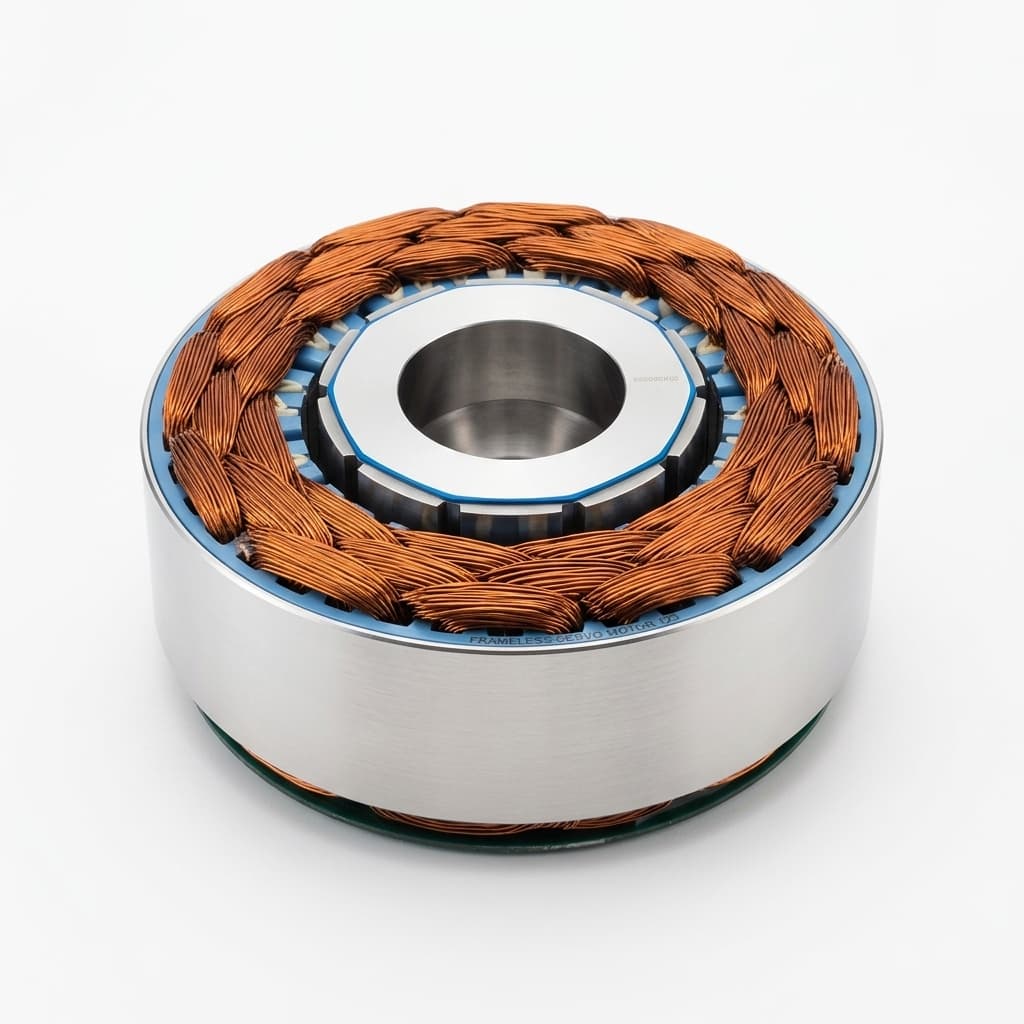
Frameless Servo Motor Winding Customization: Optimizing KV Rating and Phase Resistance
Learn when to request frameless servo motor winding customization, how KV rating changes phase resistance, and what to send suppliers for RFQ review.
For many engineering and procurement teams, frameless servo motor winding customization starts with a mechanical constraint: the motor must fit inside a specific robotic joint, exoskeleton, or medical device housing. You browse a supplier's catalog, find a stator and rotor set with the perfect outer diameter and axial length, but then you hit a roadblock—the electrical specifications don't match your system.
Perhaps the motor spins too fast at your 48V DC bus limit, or it draws too much continuous current for your chosen servo drive. At this critical juncture, buyers face a choice: do you abandon the motor size and start over, do you change your entire servo drive architecture, or do you request a custom stator winding?
Because frameless motors lack an outer housing and are integrated directly into your mechanics, motor manufacturers frequently offer winding customization as a standard B2B service. By altering the copper coils inside the stator slots, a factory can drastically change the motor's voltage, speed, and current characteristics without altering a single millimeter of the mechanical footprint.
This guide provides a deep dive into frameless motor winding customization. We will explore the inverse relationship between KV rating and phase resistance, explain the physical limits of stator "fill factor," and provide a decision framework to help you determine whether an off-the-shelf (COTS) motor or a custom-wound solution is the most cost-effective path for your direct-drive application.
Scope, Date, and Limits
This guide is dated July 23, 2026 and is written for global OEM engineering and procurement teams evaluating frameless servo motor kits for robotics, medical devices, gimbals, humanoid joints, and compact direct-drive axes. It explains buyer-side winding trade-offs before supplier nomination; it does not replace supplier-specific electromagnetic simulation, prototype thermal testing, safety certification, or your final drive tuning.
For adjacent checks, pair this article with our torque-speed curve interpretation guide, frameless motor thermal design guide, and evidence-based RFQ procurement checklist. If your target bus voltage, current limit, speed, and torque are already known, send them through the engineering contact page for a winding feasibility screen.
1. The Anatomy of a Custom Winding: Turns and Gauge
To understand winding customization, you must look at the copper wire wrapped around the teeth of the stator lamination stack. When a manufacturer customizes a winding, they are manipulating two primary variables:
- Number of Turns: How many times the copper wire is wrapped around each magnetic pole.
- Wire Gauge (AWG / Diameter): The thickness of the individual copper strands used for the winding.
These two variables are locked in a zero-sum game dictated by the physical space inside the stator, known as the slot area. You cannot infinitely increase the thickness of the wire while also increasing the number of turns—the copper simply will not fit. This geometric limit is called the Fill Factor.
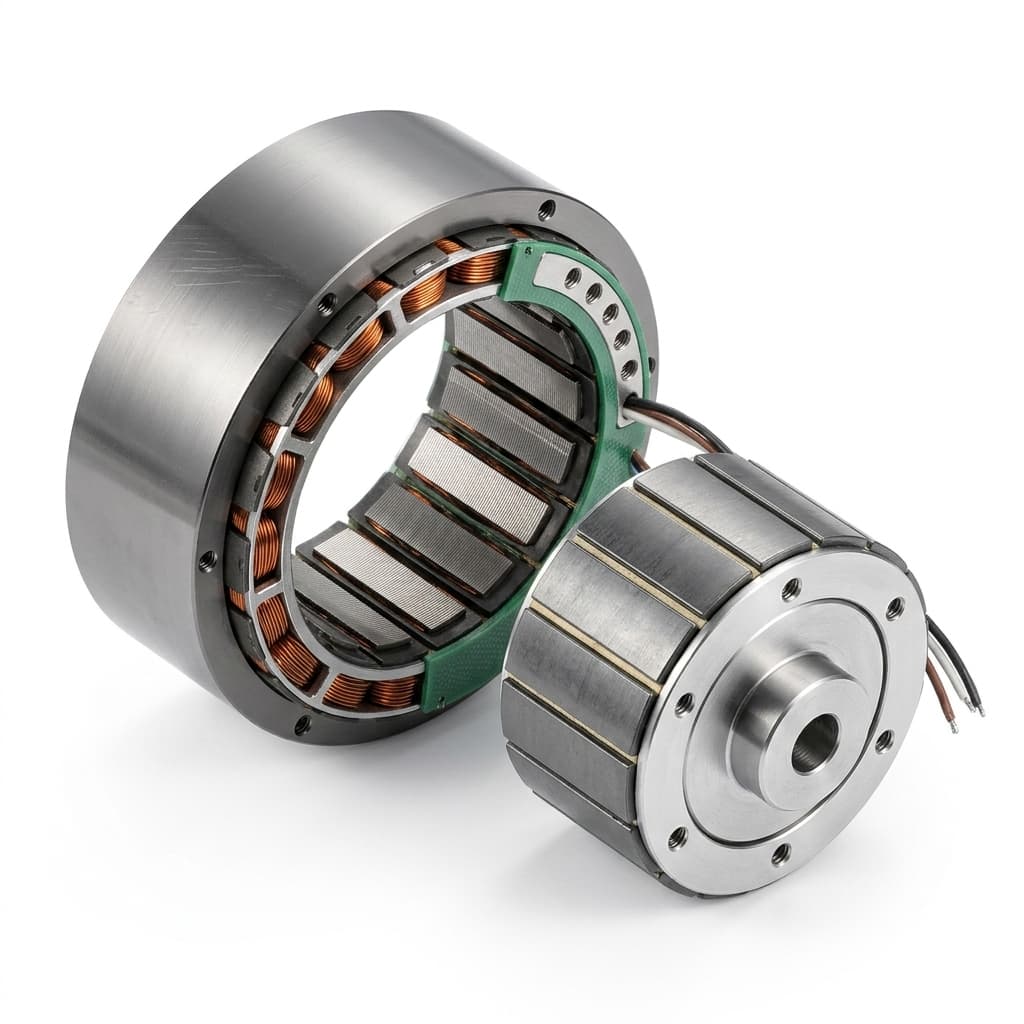 Close-up view of copper coil windings in a frameless servo motor stator. Note the density of the wire packing within the stator slots.
When you request a change to the motor's speed or torque constant, the factory must calculate a new combination of turns and wire gauge that still fits within the standard 40% to 50% fill factor typical of high-performance frameless motors. If the requested electrical parameters require more copper than the slots can hold, the customization is physically impossible, and you must move to a motor with a larger outer diameter.
2. Deciphering the KV Rating (Motor Velocity Constant)
The most common reason engineers request a custom winding is to adjust the KV rating, also known as the motor velocity constant or back-EMF constant (Ke).
The KV rating defines how fast the motor will theoretically spin (in RPM) for every one volt (1V) of electricity applied to it, assuming no mechanical load. For example, a motor with a 100 KV rating powered by a 48V supply has a theoretical maximum no-load speed of 4,800 RPM.
In direct-drive robotics and industrial automation, matching the motor's KV rating to the servo drive's DC bus voltage is critical for optimal system efficiency.
The Rule of Turns and KV
The relationship between the stator winding and the KV rating is strictly inversely proportional:
- Fewer Turns = Higher KV: The motor will spin faster per volt, but it will require more current to produce a given amount of torque.
- More Turns = Lower KV: The motor will spin slower per volt, but it will generate more torque per amp of current (Kt, the torque constant, increases).
If your mechanical engineers have designed a high-reduction harmonic drive gear system, you might need a motor that spins very fast. In this case, you would ask the factory to rewind the stator with fewer turns.
Conversely, if you are building a true direct-drive rotary index table where the load is bolted directly to the rotor, you need massive torque at very low speeds. You would ask the factory to rewind the stator with more turns to lower the KV rating and maximize the torque constant (Kt).
3. The Irony of Low KV: Phase Resistance and Thermal Bottlenecks
Procurement teams often look at a catalog, see that a lower KV motor produces more "torque per amp," and immediately assume it is the superior choice because it requires a smaller, cheaper servo drive. However, this assumption ignores the most critical side effect of winding customization: Phase Resistance.
Remember the geometric limit of the stator slots. If you request a lower KV rating, the factory must wrap more turns of wire around the stator teeth. Because the slot space is limited, they are forced to use a thinner wire gauge to make all those extra turns fit.
What happens when you push electricity through a wire that is both longer (more turns) and thinner (smaller gauge)? The electrical resistance skyrockets.
Copper Losses (I^2R)
The primary source of heat in a continuous-duty frameless motor is copper loss, calculated as Current Squared multiplied by Resistance (I^2R). When you customize a winding for a very low KV rating, the phase resistance increases dramatically.
Even though the motor requires less current to generate torque, the sharply elevated resistance means the motor will generate significantly more heat for the same mechanical output power. In a frameless motor—where the customer is entirely responsible for designing the thermal heatsink housing—excessive phase resistance can easily lead to catastrophic overheating and coil insulation failure.
Key Sourcing Insight: Never request a custom low-KV winding without simultaneously requesting the updated Phase-to-Phase Resistance specification from the manufacturer. You must run a thermal calculation to ensure your housing can dissipate the resulting heat.
If the supplier's proposed resistance increase pushes the winding temperature close to your insulation limit, revisit the mechanical heat path before approving samples. Our frameless servo motor product overview can help procurement teams separate standard model selection from custom winding review before the RFQ is issued.
4. Decision Matrix: When to Customize vs. When to Adapt
To help engineering and purchasing departments navigate the trade-offs, we have developed the following decision matrix. Use this framework to evaluate whether you should request a custom winding, buy an off-the-shelf (COTS) motor, or modify your external drive hardware.
| Scenario / Constraint | Off-The-Shelf Winding | Custom Winding (Adjust KV) | Modify Drive / Gear Ratio | Recommendation & Sourcing Rationale |
|---|---|---|---|---|
| Prototype Phase (Qty 1-5) | Best Choice | Cost Prohibitive | Viable | Standard windings have 1-2 week lead times. Custom windings for prototypes often carry heavy NRE (Non-Recurring Engineering) fees and 8-12 week lead times. Stick to COTS for proof-of-concept. |
| Motor speed is 20% too slow for the DC bus | Suboptimal | Excellent Fit | Viable | Rewinding for a slightly higher KV (fewer turns, thicker wire) is a very safe customization. It lowers phase resistance and improves thermal overhead. |
| Motor requires 100A, but Drive limit is 50A | Fails Specs | Excellent Fit | Expensive | Rewinding for a lower KV (more turns) increases the torque constant, allowing the motor to produce the required torque at under 50A, saving massive costs on the servo drive. |
| Direct Drive (No Gearbox), High Continuous Torque | Viable | High Risk | Best Choice | Attempting to get massive continuous torque purely through a custom low-KV winding will result in extreme phase resistance and overheating. Add a mechanical reducer if possible. |
| Volume Production (Qty 500+) | Viable | Best Choice | Viable | At scale, NRE is amortized. Customizing the winding to perfectly match the cheapest available 48V servo drive yields the lowest Total Cost of Ownership (TCO). |
| Harsh Environment (Potted Stator required) | Viable | Careful Review | Viable | Potting compounds reduce heat dissipation slightly. If you request a high-resistance custom winding, the thermal bottleneck of the potting resin may cause premature failure. |
5. Engineering the Supply Chain: Minimum Order Quantities and NRE
From a procurement perspective, winding customization is a strategic lever. Because the factory is using the exact same stator laminations, the exact same magnetic rotor, and the same potting equipment, a custom winding does not require new hard tooling (like injection molds or stamping dies).
However, it does require a halt to the standard production line to load new wire spools, reprogram the automated CNC needle-winding machines, and run new end-of-line electrical validation tests (such as Back-EMF and Hipot testing).
Because of this setup time, motor manufacturers typically handle custom windings in one of two ways:
- NRE Fee + Low MOQ: For specialized aerospace or medical projects, factories will charge a one-time engineering fee ($2,000 - $5,000) to cover the programming and validation, allowing for a low Minimum Order Quantity (e.g., 10 units).
- Waived NRE + High MOQ: For industrial robotics, factories will often waive the engineering fee entirely if the buyer commits to a blanket order or an annual volume exceeding 250 to 500 units.
When issuing an RFQ for a custom frameless motor, always explicitly ask the supplier for their step-pricing tiers based on winding variations.
6. Sourcing Checklist: Requesting a Custom Winding
If your engineering team determines that a custom winding is the optimal path forward, do not simply send an email asking for "more torque." Provide the motor manufacturer with a comprehensive electrical boundary profile.
Use this checklist to ensure a rapid and accurate feasibility study from the factory:
- Target Bus Voltage (Vbus): State your nominal and maximum DC bus voltage (e.g., 48V nominal, 60V peak).
- Maximum Drive Current (Ipeak & Icont): Specify the absolute maximum current your servo drive can output continuously and for peak bursts.
- Target Operating Speed (RPM): Define the continuous operating speed and the absolute maximum rapid-traverse speed.
- Required Continuous Torque (N.m): Specify the torque required at the target operating speed.
- Ambient Temperature & Thermal Limit: State the maximum internal temperature your housing can safely reach, allowing the factory to calculate if the new phase resistance will cause overheating.
- Insulation Class: Confirm if you require Class F (155 deg C) or Class H (180 deg C) magnet wire, which affects the thickness of the wire enamel and the overall fill factor.
7. Frequently Asked Questions (FAQ)
Does changing the winding alter the motor's cogging torque?
No. Cogging torque is primarily a mechanical phenomenon caused by the magnetic attraction between the permanent magnets on the rotor and the steel teeth of the stator. Changing the copper wire wrapped around the teeth does not change the geometry of the steel or the magnets, so the cogging torque profile remains identical to the standard catalog motor.
If I request a lower KV rating, will the motor physically weigh more?
Generally, no. Motor manufacturers optimize their standard windings to achieve the highest possible fill factor (putting as much copper into the slots as geometrically possible). A custom winding simply changes the ratio of wire thickness to turn count, but the total volume (and therefore weight) of the copper inside the slots remains virtually unchanged.
Can I customize the winding to run on AC voltage instead of DC?
Frameless servo motors are fundamentally permanent magnet synchronous motors (PMSM). They do not run directly on raw AC mains power (like an induction motor). They require a servo drive to electronically commutate the power. However, you can certainly request a custom winding optimized for a high-voltage drive that is powered by rectified 220V or 400V AC mains.
How long does a winding feasibility study take?
A reputable motor manufacturer should be able to run a motor winding simulation and provide a theoretical data sheet (including the new Ke, Kt, Phase Resistance, and Inductance) within 3 to 5 business days.
8. Sourcing Standards and References
The physical laws governing motor customization are universal. When evaluating supplier proposals or conducting independent thermal analysis, we recommend referencing the following engineering standards and resources:
- SimpleFOC: Practical motor-control documentation explaining KV, torque constant, phase resistance, and BLDC/PMSM drive behavior. Review the documentation.
- Motion and Mechatronics: Direct-drive engineering guidance on matching motor electrical behavior to servo drive voltage, current, and application speed requirements. Browse their direct-drive resources.
- IEC 60034-1: Rating and performance standard for rotating electrical machines; useful when aligning supplier torque, temperature, and insulation claims. Review the standard listing.
- IEC 61800-9-2: Drive-system efficiency and motor-system context for evaluating how motor winding choices interact with servo drive selection. Review the standard listing.
Next Steps for Your Project
Whether you are designing a high-speed spindle or a high-torque robotic exoskeleton, optimizing the winding is one of the most powerful tools for maximizing efficiency without increasing the footprint of your device.
If your current off-the-shelf frameless motor is drawing too much current, overheating, or failing to reach target speeds at your designated bus voltage, it is time to evaluate a custom winding. Contact our engineering team today with your target KV rating and mechanical envelope, and we will provide a feasibility study and custom torque-speed curve within 48 hours.
Author

Categories
More Posts
Frameless Servo Motor Rotor Mounting: Press Fit, Shrink Fit, or Gluing?
Compare frameless servo motor rotor mounting methods: gluing, press fit, and shrink fit, with torque risks, tolerances, QC checks, and RFQ guidance for OEMs.
Back-EMF Testing for Frameless Motors: Why It Matters in Supplier Quality Control
A practical guide for OEM buyers on using Back-EMF waveform, phase difference, THD, resistance, and insulation checks to qualify frameless motor suppliers.
How to Read a Frameless Servo Motor Torque-Speed Curve Before You Select a Motor
Learn how engineers should interpret continuous torque, peak torque, bus voltage, thermal limits, and duty cycle when reading torque-speed curves for frameless servo motors.