
Frameless Servo Motor Compliance & EU Machinery Regulation (EU) 2023/1230: CE Boundaries, LVD, UL, and OEM Procurement Documentation
Navigate frameless servo motor compliance for 2027: EU Machinery Regulation (EU) 2023/1230 boundaries, 48V vs. 400V LVD scope, UL 1004-1, RoHS, and PFAS readiness.
A standalone frameless servo motor kit—an unhoused stator and rotor—cannot carry a standalone Machinery CE mark or full UL Listed motor mark, because its housing, bearings, grounding, and live-part protection belong to the OEM's final assembly. Treating a frameless kit like an off-the-shelf housed motor creates customs holds, failed Notified Body or NRTL audits, and late-stage redesigns. With EU Machinery Regulation (EU) 2023/1230 replacing Directive 2006/42/EC on 20 January 2027, procurement and engineering teams must lock down component boundaries, voltage-dependent directive scope, and material declarations before releasing production purchase orders.
For global OEM buyers, importers, and distributors, the practical procurement rule is straightforward: buy frameless motor kits with verifiable component-level test evidence, RoHS/REACH material traceability, and integration limits—never on a vague "CE certified" catalog claim.
Published and reviewed: 2026-11-16. Scope: Global OEM procurement, regulatory compliance, and motion control engineering teams integrating unhoused frameless PMSM/BLDC stator-rotor kits into robotic joints, medical systems, semiconductor tools, and industrial automation. This guide summarizes regulatory boundaries and supplier documentation expectations; it is technical procurement guidance, not legal advice. Always confirm final market conformity with your notified body, NRTL, or regulatory counsel.
If you are qualifying a motor family for 2027 export programs, review our compliance documentation scope or request a pre-PO compliance and engineering pack with your target market, bus voltage, and assembly drawings.
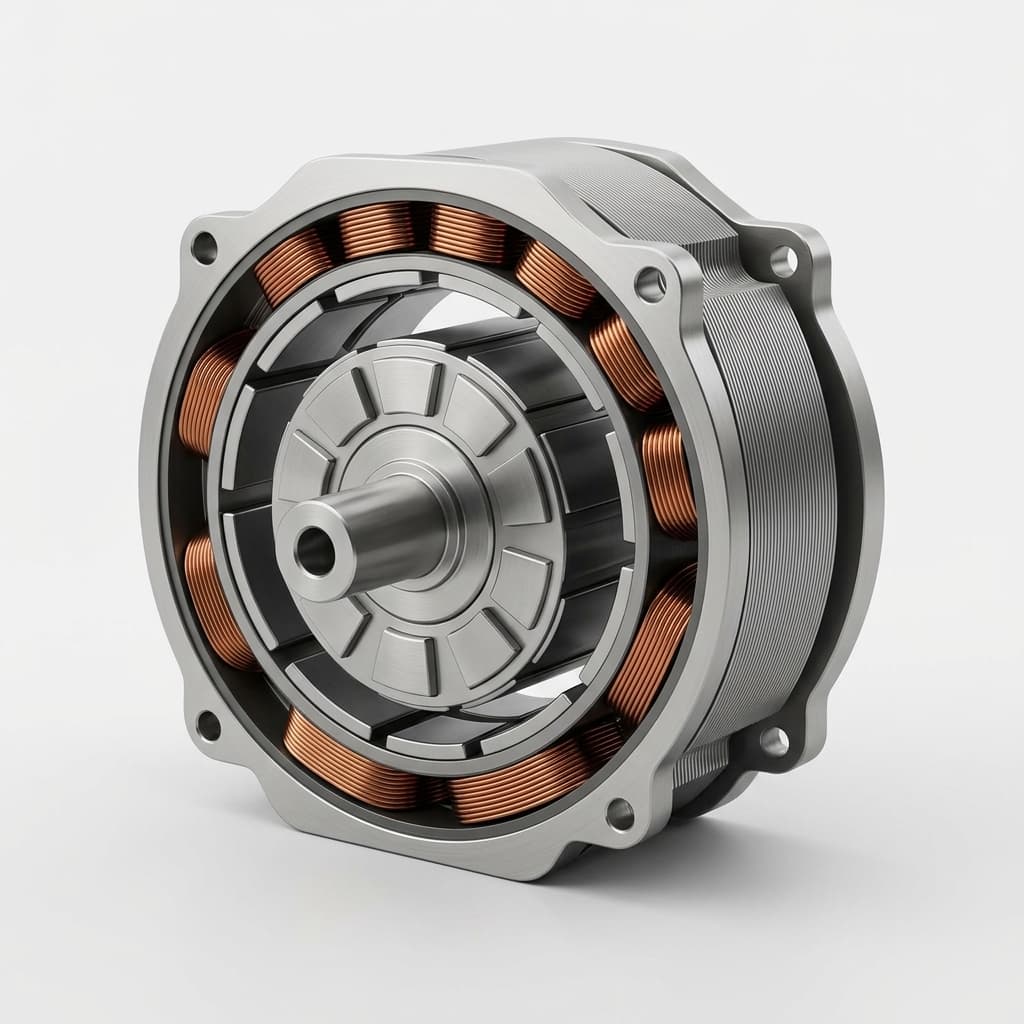
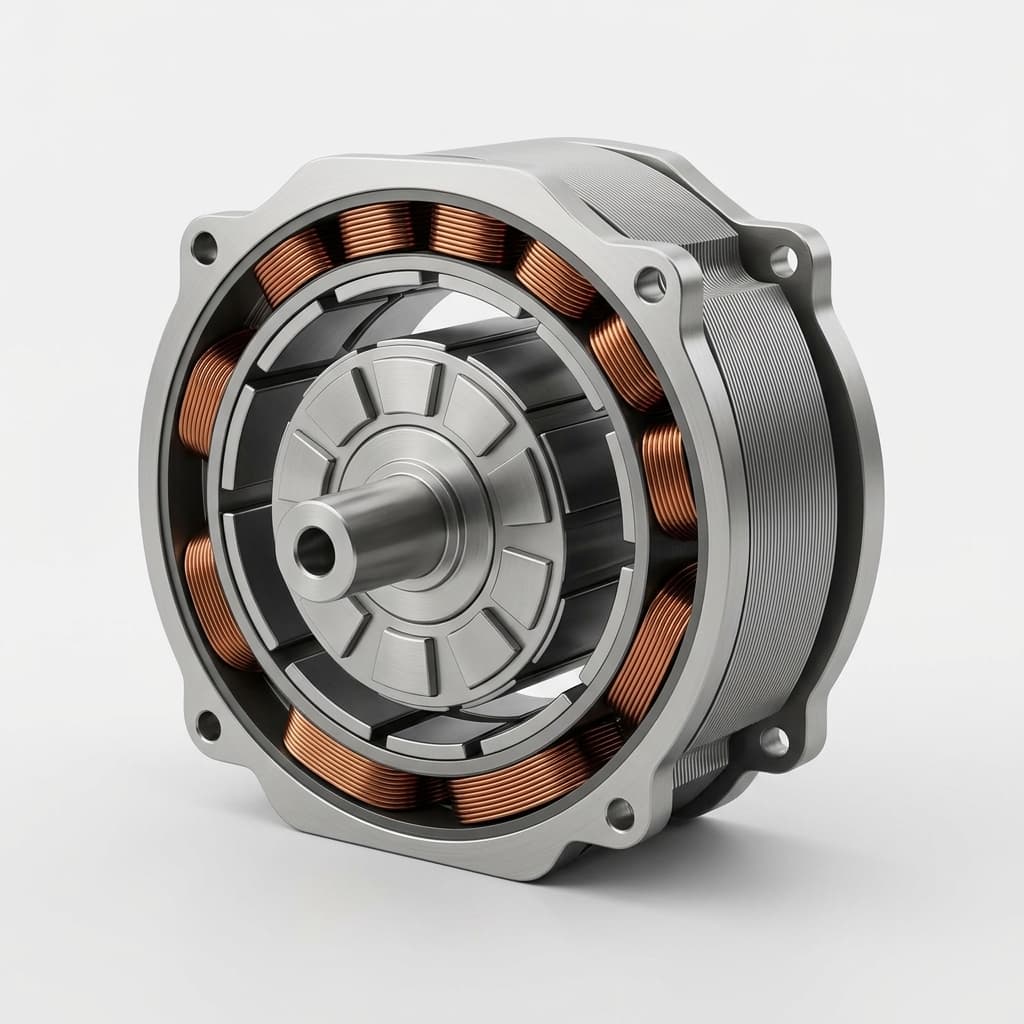
Frameless stator and rotor kit prior to housing integration. Because the kit ships without an enclosure, shaft, or bearings, electrical protection, mechanical guarding, and final system conformity depend on the OEM's host assembly.
1. Why Frameless Motor Kits Break Standard "CE Certified Motor" Assumptions
When procurement teams transition from housed servo motors to frameless kits, the biggest compliance mistake is copying the supplier qualification template from housed motors. A housed motor arrives with an enclosure, shaft seal, bearing support, terminal box, and protective earth stud. A frameless motor arrives as two separate mechanical parts: a wound stator core and a permanent-magnet rotor ring.
Under Regulation (EU) 2023/1230, which repeals Directive 2006/42/EC starting 20 January 2027, the legal distinction between a component, partly completed machinery (PCM), and completed machinery determines which documents are valid and who signs them:
1.1 Component vs. Partly Completed Machinery Under (EU) 2023/1230
In Regulation (EU) 2023/1230, partly completed machinery (PCM) is defined as an assembly that is not yet machinery because it cannot perform a specific application on its own and is only intended to be incorporated into or assembled with machinery or other PCM.
- A bare frameless stator and rotor kit is typically treated as an electromechanical component rather than complete machinery, and often sits below the PCM threshold unless supplied as a pre-assembled drive unit with bearings, housing, or integrated transmission. Either way, it cannot carry a Machinery CE mark.
- An assembled joint module or housed actuator built around a frameless kit (for example, a stator, rotor, strain-wave gear, encoder, and housing sold as a sub-assembly) frequently falls under Article 11 (Obligations of manufacturers of partly completed machinery). Under Article 11, the sub-assembly supplier must meet relevant Essential Health and Safety Requirements (Annex III), compile technical documentation (Annex IV, Part B), provide assembly instructions (Annex XI), and issue an EU Declaration of Incorporation—still without affixing a Machinery CE mark.
- Why buyers get burned: Some motor vendors stamp a generic "CE" logo on a frameless stator datasheet or shipping label without specifying which directive it covers. If a customs inspector or customer quality auditor asks for the underlying EU Declaration of Conformity and technical file scope, a Machinery CE mark on an unhoused stator-rotor pair is invalid.
1.2 What Changes on 20 January 2027 (Transition, Digital Docs, and Importer Checks)
There is no rolling grace period after the cutoff: products placed on the EU market under Directive 2006/42/EC before 20 January 2027 may continue to be made available, but anything placed on the market from 20 January 2027 onward must conform to Regulation (EU) 2023/1230. Three operational changes hit OEM procurement directly:
- Explicit Economic Operator Checks: Because Regulation (EU) 2023/1230 aligns directly with the EU New Legislative Framework (NLF), importers and distributors have explicit legal duties to verify that technical documentation, manufacturer identification, and assembly instructions are present before placing PCM or regulated products on the market.
- Digital Assembly Instructions (With Paper Fallback): Regulation (EU) 2023/1230 permits assembly instructions for PCM (Annex XI) and instructions for machinery to be supplied in digital format (such as a persistent QR code or URL linked to the exact model and revision), provided they remain accessible throughout the expected product lifecycle and can be downloaded/printed. However, suppliers must still provide paper copies free of charge upon request within statutory timelines.
- Tighter Integration Specifications: For frameless kits and PCM actuators, vague datasheets fail Annex XI expectations. Your supplier's assembly documentation should explicitly state winding thermal class, maximum allowable winding temperature, air-gap concentricity tolerances, rotor retention limits, earthing/bonding instructions, and compatible drive/bus-voltage limits so your system-level risk assessment has verifiable inputs.
2. Voltage-Driven Scope Split: 48V DC Robotics vs. 300V–400V DC Industrial Axes
A common blind spot in frameless motor RFQs is assuming that Low Voltage Directive (LVD) 2014/35/EU applies identically to every frameless motor. In reality, bus voltage splits your compliance path in two.
Under Article 1 of Directive 2014/35/EU, the Low Voltage Directive applies to electrical equipment designed for use with a voltage rating between 50 V and 1,000 V AC, and between 75 V and 1,500 V DC (excluding Annex II exceptions).
2.1 Below 75 V DC (24V / 48V / 54V Battery-Powered Robotics & AMRs)
Humanoid robots, quadrupeds, collaborative mobile manipulators, and 48V automated guided vehicles (AGVs/AMRs) operate below the 75 V DC LVD threshold:
- LVD Scope: A 48V DC frameless motor kit falls outside the mandatory voltage scope of Directive 2014/35/EU. You should not request or accept an LVD CE Declaration of Conformity for a 48V-only motor kit.
- What Still Applies: Falling outside LVD does not eliminate electrical safety or quality testing. Your OEM system must still satisfy EMC, battery/charger safety, RoHS/REACH, and machinery safety requirements (including thermal burn limits on accessible joint housings and short-circuit/overcurrent protection). Furthermore, fast-switching GaN/SiC drives at 48V still create voltage overshoot; procurement should still require phase-to-phase and phase-to-ground insulation resistance and hipot acceptance tests appropriate to the winding insulation class.
2.2 Above 75 V DC (300V–400V DC Bus Industrial & Semiconductor Axes)
Industrial servo drives fed from rectified 230V/400V AC mains typically run a 310V–560V DC bus (or higher). This places the motor system squarely inside the 75–1,500 V DC LVD range (or governed by the electrical safety requirements referenced through the Machinery Regulation):
- Insulation Coordination & PDIV: At 300V–400V+ DC bus with SiC or IGBT PWM switching, peak transient voltages at the stator terminals can exceed the nominal DC bus significantly. As covered in our inverter-duty insulation and dV/dt guide, procurement must specify slot-liner thickness, phase-to-phase separator paper, impregnation/potting integrity, and hipot / partial discharge inception voltage (PDIV) test parameters rather than relying on a generic "Class F" label.
- Creepage, Clearance, and Grounding: Because a frameless stator has exposed copper end-turns and solder/splice joints, the OEM's housing design establishes the final creepage and clearance distances to grounded metalwork. Suppliers must provide exact end-turn dimensional envelopes (including maximum axial protrusion and lead-exit bend radius) in the released CAD/STEP package so your mechanical team does not pinch insulation or violate clearance margins.
3. North American Market: UL 1004-1 & Recognized Component Boundaries
If your frameless-motor-driven equipment ships to the United States or Canada, procurement often asks for "UL Listed motors." For an unhoused frameless kit, that request usually misses how UL motor certification works.
According to UL's historical Industrial Motor Listing Program guidance (a 2009 copyrighted reference that explicitly notes it may not reflect later changes, cited here for structural background rather than as a complete current rulebook), a UL Listed motor is evaluated for field installation, including protective enclosures, mechanical guarding, strain relief, and wiring compartments.
A frameless motor kit lacks all of those structural features. Consequently:
- UL Recognized Component (UR) vs. UL Listed: Within that UL motor program framework, frameless stator/rotor kits are evaluated—if certified at component level—as UL Recognized Components, meaning they are incomplete in certain constructional features or restricted in performance capabilities and depend on the host equipment for final enclosure, grounding, and protection against contact with live parts. Always verify current ANSI/UL 1004-1 (Rotating Electrical Machines — General Requirements) edition rules and active category requirements directly with your NRTL.
- What Procurement Should Actually Verify: Many custom or low-volume frameless motor kits do not carry an individual UL file number for every winding variant. Even when a full UL Recognized motor file is not present on a custom stator, your NRTL (UL, CSA, Intertek/ETL, TÜV) will inspect the UL-recognized electrical insulation system (EIS) and component materials during end-product evaluation:
- Magnet Wire: UL-recognized enamel rating and thermal class (e.g., Class F 155°C or Class H 180°C).
- Slot Liners & Phase Separators: Traceable film/aramid paper specification and thickness.
- Impregnation Varnish / Potting Resin: UL 94 flammability rating and thermal index compatibility with the magnet wire.
- Lead Wire & Sleeving: UL AWM style number, voltage rating, temperature rating, and flame rating (e.g., VW-1).
- Thermal Sensors: Dielectric separation rating between the embedded PT1000/NTC/PTC and the stator winding, as detailed in our thermal sensor selection guide.
Asking the motor supplier for a bill of insulation materials (with UL RTI / AWM traceability) upfront saves weeks during your end-product NRTL audit.
4. Chemical & Material Compliance: RoHS 3, REACH SVHC, and PFAS Monitoring
Electrical and mechanical compliance only get a product through customs if the underlying material declarations match current chemical regulations. As of November 2026, procurement teams must manage two layers: established RoHS/REACH declarations and potential PFAS fluoropolymer restriction risk on high-temperature motor lead wires.
4.1 RoHS 3 (2011/65/EU & 2015/863) and REACH SVHC Traceability
Directive 2011/65/EU and Delegated Directive (EU) 2015/863 restrict ten hazardous substances (including lead, cadmium, mercury, hexavalent chromium, PBB, PBDE, and four phthalates) in electrical and electronic equipment. For frameless servo motors, procurement should audit three specific sub-materials rather than accepting a one-line "RoHS compliant" letter:
- Solder Joints & Termination Lugs: Confirm lead-free solder (or explicitly document any valid Annex III exemption if high-melting-temperature solder is used in specialized assemblies).
- Brass / Copper Alloy Terminals or Retaining Rings: Verify whether machined brass hardware uses lead-alloyed machining stock relying on RoHS Annex III Exemption 6(c) and track its validity/expiration status.
- Potting Epoxies, Magnet Adhesives, and PVC/Silicone Sleeving: Confirm compliance with the four restricted phthalates (DEHP, BBP, DBP, DIBP) and request current REACH SVHC screening against the latest ECHA Candidate List.
4.2 ECHA PFAS Watchpoint: PTFE, FEP, and PFA Lead Wires
High-density frameless stators frequently use PTFE, FEP, PFA, or ETFE fluoropolymer insulation on phase lead wires and thermal sensor leads because fluoropolymers offer thin walls, 200°C+ thermal endurance, and chemical resistance.
Under ECHA's PFAS regulatory process, fluoropolymers fall within the broad chemical definition of PFAS. Any EU-wide restriction requires scientific and socio-economic committee evaluation (RAC and SEAC) followed by European Commission decision-making and potential transition periods. As of 2026-11-16, exact committee completion status, industrial electrical insulation derogations, and any final effective dates remain unconfirmed and subject to ongoing EU review—but BOM mapping cannot wait until enforcement.
Smart procurement action right now: ask your motor supplier to flag every fluoropolymer-insulated wire, heat-shrink tube, or tape in the stator BOM today. If your product has a 5-to-10-year industrial lifecycle, qualify a non-fluoropolymer alternative (such as cross-linked silicone or high-temperature polyimide/PEEK where bend radius and temperature allow) in parallel during prototype validation.
5. Frameless Motor Compliance & Documentation Benchmark Matrix
Use this matrix during supplier qualification and RFQ comparison to separate valid component documentation from misleading marketing claims.
| Compliance / Standard | Trigger for Frameless Motor Kits | Legal Responsibility Owner | Required Supplier Deliverable | Common Procurement Trap | Verification Method |
|---|---|---|---|---|---|
| EU Machinery Regulation (EU) 2023/1230 | Mandatory from 20 Jan 2027 for EU machinery & PCM | OEM for final machine; Supplier if selling PCM actuator | Component integration limits; or Art. 11 Declaration of Incorporation + Annex XI instructions for PCM | Accepting a "Machinery CE" sticker on a bare stator/rotor kit | Audit declaration legal basis and scope against product BOM |
| Low Voltage Directive (LVD) 2014/35/EU | Bus/winding rated 75–1,500 V DC or 50–1,000 V AC | OEM for final electrical equipment; Supplier provides dielectric data | Hipot voltage/duration/leakage report, insulation class, creepage envelope | Requesting LVD CE on a 48V DC motor, or skipping PDIV on 400V DC | Cross-check rated bus voltage vs. test voltage and pass/fail criteria |
| UL 1004-1 / NRTL Component Evaluation | North American market entry for motor-driven equipment | OEM for end-product Listing; Supplier for EIS/material data | UL Recognized file (if applicable) + UL insulation material list (wire, liner, resin, leads) | Assuming a frameless kit can be "UL Listed" without an enclosure | Verify UL AWM / RTI traceability of every insulating layer |
| RoHS 3 (2011/65/EU + 2015/863) | All EU-bound electrical/electronic equipment (and global equivalents) | Importer / OEM placing finished product on market | Signed RoHS declaration specifying part numbers, exemptions, and lab test date | Accepting a generic company-wide PDF without part-number scope | Audit solder, brass terminals, adhesives, and cable jackets |
| REACH SVHC & ECHA PFAS Tracking | EU imports & global supply-chain substance reporting | Importer / OEM (article notification & SCIP where >0.1% w/w) | Current SVHC declaration + PFAS/fluoropolymer BOM flag (PTFE/FEP/PFA) | Ignoring PTFE lead-wire exposure until customer audit blocks shipment | Request full material declaration (FMD) or IPC-1752A / BOM table |
| EMC (2014/30/EU) / FCC Part 15 | Active electronic drives & switching systems | OEM / System Integrator (drive + cable + motor + housing) | Shielding, grounding, and Back-EMF / phase-balance QC data | Expecting a passive stator/rotor kit to carry standalone EMC certification | Validate full axis (drive + motor + encoder) in final housing |
| Dual-Use / Rare-Earth Export Traceability | Cross-border shipment of high-grade NdFeB rotors (SH/UH/EH) | Exporter & Importer under applicable trade rules | Accurate HS code, magnet grade specification, and origin paperwork | Unverified magnet grade substitutions delaying customs clearance | Match lot inspection sheet to purchase order and customs invoice |
6. Substantial Modification & Retrofit Traps Under (EU) 2023/1230
Regulation (EU) 2023/1230 introduces explicit legal rules for substantial modification of existing machinery. This directly affects OEMs, system integrators, and aftermarket distributors who supply frameless servo motor kits for machine upgrades.
If an integrator retrofits an existing machine in the field with a higher-torque or higher-speed frameless motor kit that alters the machine's original performance envelope, introduces new hazards, or changes safety-related control functions (such as braking torque, maximum axis velocity, or thermal dissipation limits beyond the original risk assessment), the party performing that modification can legally become the manufacturer of the modified machine.
That status triggers a full conformity assessment, updated technical file, new EU Declaration of Conformity, and new CE marking. Procurement teams managing retrofit or spare-part programs should explicitly document whether a replacement stator/rotor kit is an identical electrical/mechanical form-fit-function replacement or an upgrade requiring engineering change control.
7. OEM Procurement & Compliance Acceptance Checklist
Before approving a frameless servo motor drawing revision or releasing a production purchase order for 2027 delivery, verify that your supplier package covers these eight deliverables:
- 1. Legal Classification & Scope Statement: Confirm in writing whether the purchased SKU is a bare component (stator + rotor kit) or partly completed machinery (assembled actuator). Reject invalid Machinery CE claims on unhoused kits.
- 2. Annex XI Integration & Safety Limits (for 2027 EU Programs): Obtain documented mounting tolerances, maximum rotor speed, continuous/peak current, maximum winding temperature, and protective earthing/bonding requirements for your risk assessment file. Confirm digital instruction URL persistence and paper-copy availability if procuring PCM.
- 3. Voltage-Matched Dielectric Test Evidence: Align hipot test voltage, dwell time, and leakage current limits to your actual DC bus (48V vs. 300V–400V+). Require lot-level or serialized pass/fail records rather than a generic "hipot passed" checkbox.
- 4. UL Insulation Material Traceability: Collect exact manufacturer grades and UL ratings (thermal class, RTI, AWM style, UL 94) for magnet wire, slot liners, phase separators, potting resin, and lead wires.
- 5. Part-Number-Specific RoHS 3 & REACH SVHC Declarations: Ensure declarations list exact motor part numbers, revision levels, issue dates, and any RoHS Annex III exemptions (such as 6(c) copper alloys or 7(a) solder).
- 6. Fluoropolymer (PFAS) Lead-Wire Flagging: Identify whether phase leads, sensor leads, or sleeving contain PTFE, FEP, PFA, or ETFE, and document qualified non-fluoropolymer alternatives if your product has a multi-year industrial lifecycle.
- 7. Engineering Change Control (PCN) Clause: Require written supplier notification before any change to magnet grade, adhesive, potting compound, insulation film, lead wire, or manufacturing site—any of which can invalidate your system certification.
- 8. Serialized Incoming QC & Traceability: Link compliance packs to batch/serial numbers covering Back-EMF, phase resistance, inductance, and dielectric withstand so field audits can trace every delivered rotor and stator.
8. Frequently Asked Questions (FAQ)
Q1: Can a frameless servo motor supplier put a CE mark on the stator or shipping box?
For an unhoused stator and rotor kit, a Machinery Directive / Regulation (EU) 2023/1230 CE mark is not valid, because the kit cannot operate independently as machinery. Depending on the rated voltage, a component might be evaluated against LVD insulation principles (if rated 75–1,500 V DC or 50–1,000 V AC) or RoHS, but the OEM remains responsible for CE marking the final machine. Always verify which directive any CE claim references.
Q2: What happens on 20 January 2027 if our supplier's paperwork still references Directive 2006/42/EC?
Directive 2006/42/EC is repealed on 20 January 2027. Products already placed on the EU market before that date can remain on the market, but new shipments placed on the EU market from 20 January 2027 onward must comply with Regulation (EU) 2023/1230. If you buy integrated actuators (partly completed machinery), their Declaration of Incorporation and Annex XI assembly instructions must be updated to reference (EU) 2023/1230 before your 2027 shipments clear EU customs.
Q3: Our robot runs on a 48V DC battery—do we still need hipot and insulation documentation?
Yes. While a 48V DC bus is below the 75 V DC lower limit of the Low Voltage Directive (2014/35/EU), you still need dielectric withstand (hipot) and insulation resistance verification to catch winding damage, slot-liner pinholes, and GaN/SiC PWM switching stress during incoming QC.
Q4: Are digital assembly instructions allowed under Regulation (EU) 2023/1230?
Yes. Regulation (EU) 2023/1230 allows instructions (including Annex XI assembly instructions for partly completed machinery) to be provided in digital format, provided they remain accessible, printable, and tied to the exact product model—while preserving the buyer's right to request a paper copy free of charge.
Q5: Why won't our motor supplier give us a "UL Listed" certificate for a custom frameless kit?
In UL's motor certification framework (as described in UL's historical motor listing program guidance, subject to current ANSI/UL 1004-1 edition verification with your NRTL), UL Listing applies to complete motors with protective enclosures, strain relief, and field-wiring compartments. Frameless kits are incomplete constructions that rely on the OEM's housing for live-part protection and grounding, so they are typically evaluated as UL Recognized Components or via their UL-recognized insulation system materials inside your final NRTL product certification.
Q6: Should we ban PTFE lead wires from our frameless motor RFQs right now?
Not necessarily—for high-temperature, tight-bend-radius joints, PTFE/FEP remains widely used today, and as of 2026-11-16, any final EU PFAS restriction scope, industrial derogations, and effective transition dates under REACH remain unconfirmed and subject to ongoing ECHA and European Commission review. However, you should require BOM disclosure of all fluoropolymers now and qualify an alternative wire insulation if your platform has a multi-year production horizon.
9. Sources & Regulatory References
References verified on 2026-11-16 using official EU legal texts, ECHA regulatory topic references, and historical UL guidance. These references establish the regulatory framework; final applicability depends on your product architecture and target jurisdiction.
- European Union (EUR-Lex): Regulation (EU) 2023/1230 on machinery, repealing Directive 2006/42/EC — Establishes application date of 20 January 2027, Article 11 obligations for partly completed machinery, Annex III essential health and safety requirements, Annex IV Part B technical documentation, and Annex XI assembly instructions.
- European Union (EUR-Lex): Directive 2014/35/EU (Low Voltage Directive) — Article 1 defines electrical equipment scope as 50–1,000 V AC and 75–1,500 V DC.
- European Union (EUR-Lex): Directive 2011/65/EU (RoHS 2) and Delegated Directive (EU) 2015/863 (RoHS 3) — Restricts ten hazardous substances in electrical and electronic equipment and defines Annex II limits.
- European Chemicals Agency (ECHA): Per- and polyfluoroalkyl substances (PFAS) hot topic — ECHA's regulatory topic page on PFAS restriction activities covering fluoropolymers; cited for general scope context only, as live 2026 committee milestones and timelines could not be verified (URL returned HTTP 403 on 2026-11-16).
- UL (Underwriters Laboratories — Historical Background Reference): Industrial Motor Listing Program Overview (PDF, 2009 copyright material) — Historical background guidance (2009 copyright, explicitly noting it may not reflect later changes); cited solely for the structural distinction between UL Listed motors (with enclosures and wiring compartments) and Recognized Component motors (incomplete constructions requiring host-equipment evaluation). Confirm current ANSI/UL 1004-1 requirements directly with your NRTL.
Request an OEM Compliance & Engineering Documentation Pack
Do not wait for a 2027 customs hold or NRTL audit finding to discover missing insulation traceability or misaligned CE boundaries. Send your target region, DC bus voltage, mechanical envelope, and required declaration list to our export engineering team.
Explore our frameless direct-drive motor platforms and compliance resources:
- Certifications & Compliance Scope — Review our export documentation workflow, RoHS/REACH scope, and lot-level QC deliverables.
- Frameless Servo Motor Kits — Unhoused stator/rotor platforms with traceable insulation systems and serialized electrical QC.
- Hollow Shaft Frameless Servo Series — Large-aperture direct-drive motors engineered for clean internal cable routing and compact robotic joints.
- Torque Motor Series — High-torque direct-drive platforms for industrial automation, semiconductor, and precision rotary axes.
Submit your program requirements through our Contact & RFQ Consultation portal to request a pre-PO compliance matrix, insulation material list, and engineering drawing review.
Author

Categories
More Posts
Back-EMF Testing for Frameless Motors: Why It Matters in Supplier Quality Control
A practical guide for OEM buyers on using Back-EMF waveform, phase difference, THD, resistance, and insulation checks to qualify frameless motor suppliers.
Frameless Servo Motor Thermal Design: Why Air Gaps Kill Continuous Torque
A deep dive into the thermal bottlenecks of frameless motor integration. Learn how housing materials, potting compounds, and micro-air gaps drastically alter continuous torque and why catalog values need derating.
How to Read a Frameless Servo Motor Torque-Speed Curve Before You Select a Motor
Learn how engineers should interpret continuous torque, peak torque, bus voltage, thermal limits, and duty cycle when reading torque-speed curves for frameless servo motors.